HACCP vs ISO 22000 vs FSSC 22000: Which Food Safety Certification is Right for Your Business?
Author: Prashant Chavhan | Last Updated: June 2026
1. Introduction: The Certification Conundrum
You’ve built a solid food businesshygienic premises, trained staff, steady customers. Then a major buyer asks: “Which food safety certification do you hold?” Suddenly you’re staring at three acronymsHACCP, ISO 22000, FSSC 22000and every consultant gives you a different answer. HACCP is the foundation, they say. No, ISO 22000 is more comprehensive. Actually, FSSC 22000 is what global retailers demand.
The decision fatigue is realand costly. Choose wrong, and you overpay for certification your clients don’t recognise. Choose right, and you unlock export markets, win bulk contracts, and command premium pricing.
In India alone, over 4,200 food businesses now hold one or more internationally recognised food safety certifications, and the number grows 18–22% year-on-year as FSSAI pushes toward global alignment. Yet most business owners still struggle to answer a simple question: Which certification actually makes sense for my business?
This guide settles it. You’ll learn exactly what each certification covers, what it costs (in rupees), how long it takes, which buyers require it, andmost importantlywhich one fits your business type, size, and growth trajectory. By the end, you’ll have a clear, personalised answer.
2. TL;DR Verdict
Choose HACCP if you’re a small-to-medium manufacturer or exporter who needs the most cost-effective, globally recognised food safety foundation that FSSAI explicitly endorses; choose ISO 22000 if you’re a mid-to-large business wanting an integrated management system that combines HACCP with quality management; choose FSSC 22000 if you’re supplying major retailers or multinational brands (especially in Europe) and need the gold standard GFSI-recognised certification.
Still unsure? Skip to the [Decision Framework](#8-decision-framework-which-certification-for-which-business)it maps your exact business type to the right certification in under 30 seconds.
3. Quick Comparison Table
| Parameter | HACCP | ISO 22000 | FSSC 22000 |
|---|---|---|---|
| Full Name | Hazard Analysis Critical Control Point | Food Safety Management System | Food Safety System Certification |
| Standard Body | Codex Alimentarius / National | ISO (International Organization for Standardization) | Foundation for Food Safety Certification |
| GFSI Recognised? | ❌ No | ❌ No | ✅ Yes |
| Typical Cost (₹) | ₹40,000 – ₹1,50,000 | ₹1,50,000 – ₹4,00,000 | ₹3,00,000 – ₹8,00,000 |
| Implementation Time | 2–4 months | 4–8 months | 6–12 months |
| Difficulty Level | Low–Medium | Medium | Medium–High |
| Documentation Burden | Moderate (12–20 documents) | Heavy (25–40 documents) | Very Heavy (30–50+ documents) |
| Certification Validity | 1–3 years (varies by scheme) | 3 years | 3 years (with annual surveillance) |
| Global Recognition | Very High (regulatory baseline) | High | Very High (GFSI benchmarked) |
| Indian Auditor Availability | Abundant (100+ accredited bodies) | Good (40–50 accredited bodies) | Moderate (15–20 accredited bodies) |
| FSSAI Alignment | Directly referenced in Schedule 4 | Aligned but not directly referenced | Aligned, recognised for exports |
| Export Acceptance | Widely accepted, may need GFSI for top retailers | Accepted in most markets | Best for EU, UK, and major retailers |
| Renewal / Surveillance | Typically annual renewal | Annual surveillance audits | Annual surveillance + triennial recertification |
| Staff Training Required | Basic HACCP awareness | Moderate (FSMS + HACCP) | Advanced (PRPs, HACCP, FSMS) |
| Consultant Fees (₹) | ₹30,000 – ₹80,000 | ₹80,000 – ₹2,00,000 | ₹1,50,000 – ₹4,00,000 |
| Best For | SMEs, basic compliance, FSSAI Schedule 4 | Integrated management, mid-size firms | Exporters, large processors, GFSI requirement |
4. What is HACCP?
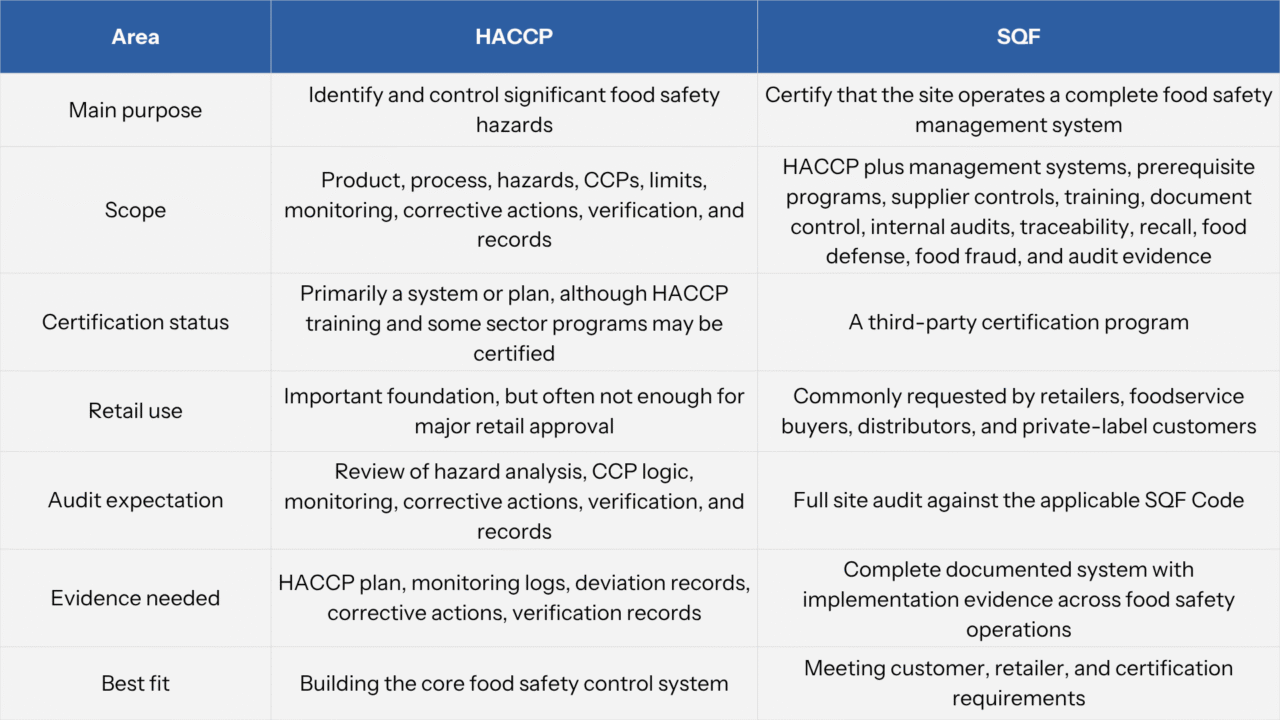
HACCP (Hazard Analysis Critical Control Point) is not so much a certification as it is a food safety management methodologythe foundational system upon which all modern food safety standards are built. Developed jointly by the Pillsbury Company, NASA, and the US Army Laboratories in the 1960s to ensure safe food for space missions, HACCP has since been adopted by the Codex Alimentarius Commission and is now the global baseline for food safety.
How HACCP Works
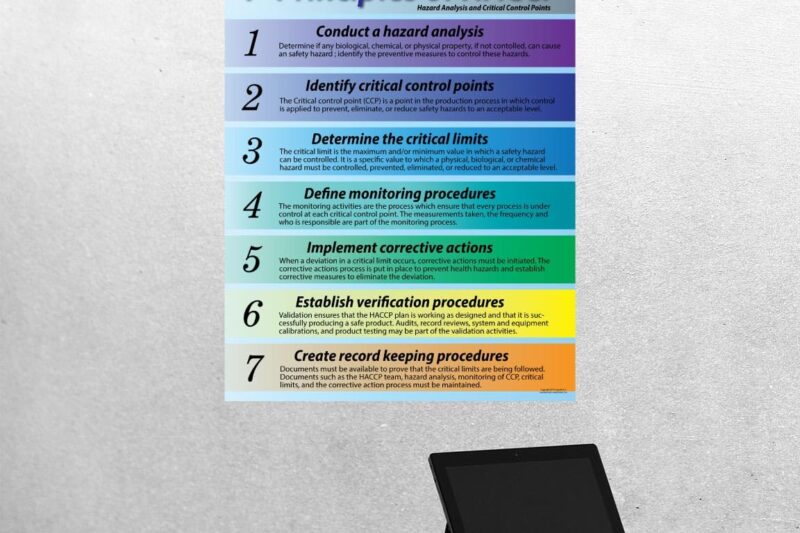
HACCP operates on seven core principles:
1. Conduct a hazard analysisidentify biological, chemical, and physical hazards at every step
2. Determine Critical Control Points (CCPs)points where hazards can be prevented, eliminated, or reduced
3. Establish critical limitsmeasurable boundaries (e.g., temperature ≥ 75°C)
4. Establish monitoring procedureshow and when CCPs are checked
5. Establish corrective actionswhat to do when a CCP deviates
6. Establish verification proceduresconfirm the system is working
7. Establish record-keepingdocumentation to prove compliance
These principles are applied through 12 implementation steps that include assembling a HACCP team, describing the product, identifying intended use, constructing a flow diagram, and on-site verification of the flow diagram before analysis begins.
Who Uses HACCP in India?
HACCP is the most widely implemented food safety system in India, used by:
– Small and medium food manufacturersspice grinders, snack makers, dairy units
– Export-oriented businessesespecially seafood, meat, and poultry processors where APEDA/MPEDA mandates HACCP
– Hotel chains and catering businessesITC Hotels, Taj, and large caterers
– FSSAI-compliant businessesSchedule 4 of FSSAI’s Licensing Regulations directly requires HACCP-based systems
– Street food vendors and small eateriesthrough simplified HACCP adoption via FSSAI’s Eat Right initiatives
HACCP Pros
| ✅ Advantage | Why It Matters |
|---|---|
| Lowest coststarting at ₹40,000 | Most affordable globally recognised system |
| Fastest to implement2–4 months | Quick compliance win |
| FSSAI Schedule 4 alignment | Direct integration with Indian regulatory compliance |
| Abundant auditors in India | 100+ accredited bodies means competitive pricing |
| Simple documentation | 12–20 documents; manageable for SMEs |
HACCP Cons
| ❌ Disadvantage | Impact |
|---|---|
| Not GFSI recognised | Rejected by top global retailers (Tesco, Carrefour, Walmart, Metro) |
| No quality management integration | Standalone food safety without supplier control or traceability framework |
| Limited scope creep | Doesn’t cover all food chain steps (e.g., feed production, transport) |
| No mandatory annual surveillance | Can lead to system drift without external oversight |
HACCP Certification Bodies in India
Major HACCP certification bodies operating in India include: Bureau Veritas (₹60,000–₹1,20,000), SGS India (₹50,000–₹1,50,000), TÜV SÜD (₹55,000–₹1,10,000), Lloyds Register (₹70,000–₹1,40,000), Intertek (₹50,000–₹1,00,000), and DNV GL (₹60,000–₹1,30,000). Note that many businesses implement HACCP without third-party certificationFSSAI’s Schedule 4 compliance requires HACCP principles, not necessarily accredited certification.
5. What is ISO 22000?
ISO 22000 is an international standard for food safety management systems (FSMS) published by the International Organization for Standardization (ISO). First released in 2005 and most recently revised in 2018, ISO 22000 integrates the HACCP principles with the Plan-Do-Check-Act (PDCA) management system approach, making it compatible with other ISO standards like ISO 9001 (quality management) and ISO 14001 (environmental management).
How ISO 22000 Works
ISO 22000 combines four key elements into a single, auditable framework:
1. Interactive communicationensures food safety information flows throughout the food chain
2. System managementthe PDCA cycle applied to both the management system and operational processes
3. Prerequisite programmes (PRPs)basic conditions and activities (hygiene, cleaning, pest control, waste management)
4. HACCP principlesintegrated as the hazard control methodology within the larger system
The 2018 revision introduced the High-Level Structure (HLS), making ISO 22000:2018 structurally identical to other ISO management system standards. This means a food business already certified to ISO 9001 can integrate ISO 22000 with minimal frictionsame clause numbering, same core management review process.
Who Uses ISO 22000 in India?
– Mid-to-large food processorsdairy (Amul, Mother Dairy), edible oil, packaged foods
– Integrated food businessescompanies already holding ISO 9001 or ISO 14001
– Contract manufacturersproducing for multiple brands where standardised FSMS is an advantage
– Food logistics and storage providerscold chain operators, warehouses, transporters
– Catering and hospitality chainslarge institutions requiring documented FSMS
ISO 22000 Pros
| ✅ Advantage | Why It Matters |
|---|---|
| ISO HLS compatibility (2018) | Easily integrates with ISO 9001, 14001, 45001single audit possible |
| Covers entire food chain | From primary production to retailapplicable to all sectors |
| Stronger documentation framework | 25–40 documents create robust, auditable FSMS |
| International recognition | Accepted in most countries for import compliance |
| Management system approach | Regular management reviews, internal audits, continuous improvement |
ISO 22000 Cons
| ❌ Disadvantage | Impact |
|---|---|
| NOT GFSI recognised | Rejected by GFSI-requiring buyers (major retailers) |
| Higher cost (₹1.5L–₹4L) | 3–4× more expensive than HACCP-only certification |
| Longer implementation (4–8 months) | Significant time investment for documentation and training |
| Complex for small businesses | Template-heavy system can overwhelm micro-enterprises |
| Fewer auditors than HACCP | 40–50 accredited bodies vs 100+ for HACCPmay cost more |
ISO 22000 Certification Bodies in India
Accredited certification bodies for ISO 22000 in India include: BSI Group (₹1,50,000–₹3,50,000), TÜV Rheinland (₹1,50,000–₹3,00,000), SGS India (₹1,50,000–₹4,00,000), Bureau Veritas (₹1,50,000–₹3,50,000), DNV GL (₹1,50,000–₹3,00,000), and LRQA (₹1,80,000–₹4,00,000). Pricing varies significantly based on site complexity, number of employees, and number of shifts.
6. What is FSSC 22000?
FSSC 22000 (Food Safety System Certification) is a GFSI-benchmarked food safety certification scheme developed by the Foundation for Food Safety Certification in the Netherlands. It is built on ISO 22000 as its foundation, adds sector-specific prerequisite programmes (PRPs), and includes additional FSSC scheme requirements beyond the ISO standard. Critically, it is recognised by the Global Food Safety Initiative (GFSI)the benchmark that major retailers and food service companies worldwide demand from their suppliers.
How FSSC 22000 Works
FSSC 22000 comprises three components:
1. ISO 22000:2018the complete food safety management system (as described above)
2. Sector-specific PRPsdetailed requirements for Category C (food and feed manufacturing), Category I (catering), Category K (transport/storage), and others
3. FSSC additional requirementsfood safety culture assessment, food defence, food fraud mitigation, allergen management, and audit reporting transparency
The FSSC 22000 scheme is structured in a 3-year certification cycle with mandatory annual surveillance audits. There is no option for “just the certificate”certified organisations must participate in the FSSC integrity programme, which includes unannounced audits and a mandatory annual update fee.
Who Uses FSSC 22000 in India?
– Export-oriented food processorsespecially those supplying Europe, UK, and Middle East
– Large-scale manufacturerswith annual turnovers exceeding ₹100 crore
– Suppliers to global retailersWalmart, Metro, Carrefour, Tesco, Aldi, and Costco
– Contract manufacturers for MNC brandsNestlé, Unilever, PepsiCo, Coca-Cola supply chain partners
– Seafood, meat, and poultry exporterswhere GFSI recognition is a non-negotiable buyer requirement
– Premium dairy and infant food producerswhere food safety risk is highest
FSSC 22000 Pros
| ✅ Advantage | Why It Matters |
|---|---|
| GFSI recognisedthe gold standard | Required by top global retailers and MNC buyers |
| Strongest food safety culture requirements | Mandates objective measurement of food safety culture |
| Food fraud and food defence integration | FSSC additional requirements address intentional contamination |
| Highest global credibility | FSSC is accepted in 155+ countries |
| Continuous improvement built-in | Annual surveillance prevents system decay |
FSSC 22000 Cons
| ❌ Disadvantage | Impact |
|---|---|
| Highest cost₹3L–₹8L+ | 8–10× more expensive than HACCP |
| Long implementation6–12 months | Significant resource commitment |
| Complex documentation30–50+ documents | Requires dedicated QA team or experienced consultant |
| Limited auditor pool in India | 15–20 accredited bodies means higher fees and scheduling delays |
| Annual surveillance + triennial recertification | Ongoing cost burden₹1L–₹2.5L per surveillance audit |
FSSC 22000 Certification Bodies in India
Fewer bodies offer FSSC 22000 accreditation in India, which impacts pricing and availability: SGS India (₹3,00,000–₹7,00,000), Bureau Veritas (₹3,50,000–₹7,50,000), BSI Group (₹4,00,000–₹8,00,000), TÜV SÜD (₹3,00,000–₹6,50,000), Lloyds Register (₹3,50,000–₹7,00,000), and DEKRA (₹3,00,000–₹6,00,000). Certification costs depend on site complexity, number of products, number of employees (audit man-days), and scope of certification.
7. Detailed Comparison
7.1 Cost Breakdown
| Cost Component | HACCP (₹) | ISO 22000 (₹) | FSSC 22000 (₹) |
|---|---|---|---|
| Consultant / Implementation | 30,000 – 80,000 | 80,000 – 2,00,000 | 1,50,000 – 4,00,000 |
| Initial Certification Audit | 40,000 – 1,50,000 | 1,50,000 – 4,00,000 | 3,00,000 – 8,00,000 |
| Annual Surveillance | 20,000 – 60,000 | 60,000 – 1,50,000 | 1,00,000 – 2,50,000 |
| Staff Training | 10,000 – 25,000 | 25,000 – 60,000 | 40,000 – 1,00,000 |
| Documentation Templates | 5,000 – 15,000 | 15,000 – 40,000 | 30,000 – 80,000 |
| Year 1 Total (approx.) | ₹85,000 – ₹2,70,000 | ₹2,70,000 – ₹7,00,000 | ₹4,70,000 – ₹13,80,000 |
Key Insight: HACCP costs roughly 20–30% of ISO 22000 and 10–15% of FSSC 22000 over a 3-year period. However, if your buyer requires GFSI certification, HACCP (or ISO 22000 alone) will not sufficeyou’ll need FSSC 22000. In that case, skipping ISO 22000 and going directly to FSSC 22000 can save you one round of implementation costs.
7.2 Implementation Timeline
| Phase | HACCP | ISO 22000 | FSSC 22000 |
|---|---|---|---|
| Gap analysis and planning | 2–3 weeks | 3–4 weeks | 4–6 weeks |
| HACCP team formation and training | 1–2 weeks | 2–3 weeks | 3–4 weeks |
| PRP development | 2–3 weeks | 3–5 weeks | 5–8 weeks |
| HACCP plan development | 3–5 weeks | 4–6 weeks | 4–6 weeks |
| FSMS documentation | Not applicable | 4–8 weeks | 6–10 weeks |
| Food safety culture / food fraud | Not required | Not required | 2–4 weeks |
| System implementation and monitoring | 2–4 weeks | 4–6 weeks | 6–8 weeks |
| Internal audit and management review | 1–2 weeks | 2–3 weeks | 3–4 weeks |
| Pre-certification audit | 1 week | 1–2 weeks | 2–3 weeks |
| Total (minimum) | 2 months | 4 months | 6 months |
7.3 Documentation Burden
| Document Type | HACCP | ISO 22000 | FSSC 22000 |
|---|---|---|---|
| HACCP Policy | 1 | 1 | 1 |
| Hazard Analysis Sheets | 5–10 | 5–15 | 10–20 |
| CCP Monitoring Records | 10–20 | 10–20 | 10–25 |
| Corrective Action Reports | 3–5 | 5–10 | 5–15 |
| PRP Documentation | 5–10 | 10–20 | 15–30 |
| FSMS Manual | Not required | 1 | 1 |
| Supplier Approval Records | 2–5 | 5–10 | 10–15 |
| Internal Audit Records | 1–2 | 5–10 | 5–10 |
| Management Review Minutes | 1 | 3–5 | 5–8 |
| Food Defence & Fraud Plan | Not required | Not required | 2–5 |
| Food Safety Culture Survey | Not required | Not required | 2–4 |
| Training Records | 5–10 | 10–15 | 10–20 |
Reality Check: These numbers are per product category, per production line. If your facility runs 500 SKUs across 5 product categories, expect 3–5× the listed document counts. Choose a certification that matches your documentation capacityFSSC 22000 without a dedicated QA lead is a recipe for non-conformances.
7.4 Auditor Availability in India
| Metric | HACCP | ISO 22000 | FSSC 22000 |
|---|---|---|---|
| Accredited Certification Bodies | 100+ | 40–50 | 15–20 |
| Audit Lead Time (from booking) | 2–4 weeks | 4–8 weeks | 8–16 weeks |
| Average Auditor Day Rate (₹) | 8,000 – 15,000 | 12,000 – 22,000 | 18,000 – 30,000 |
| Regional Coverage | All states | Major states | Tier-1 cities only |
| Hindi/Regional Language Auditors | Widely available | Moderately available | Limited to English |
Practical Tip: If you’re based in a tier-2 city (like Indore, Lucknow, Coimbatore), FSSC 22000 auditors may need to travel from Delhi, Mumbai, or Bengaluruexpect higher costs and longer scheduling delays. HACCP auditors are available in even smaller cities.
7.5 Global Recognition
| Region / Buyer | HACCP | ISO 22000 | FSSC 22000 |
|---|---|---|---|
| India (FSSAI / domestic buyers) | ✅ Excellent | ✅ Very Good | ✅ Very Good |
| GCC / Middle East | ✅ Good | ✅ Good | ✅ Excellent |
| European Union | ⚠️ Often requires GFSI for retail | ⚠️ Accepted as equivalent (varies) | ✅ Preferred (GFSI) |
| United Kingdom (post-Brexit) | ⚠️ Retailers require GFSI | ⚠️ Limited acceptance | ✅ Gold standard |
| USA (FDA FSMA) | ✅ Accepted | ✅ Accepted | ✅ Accepted |
| Southeast Asia | ✅ Widely accepted | ✅ Widely accepted | ✅ Premium preferred |
| Australia / New Zealand | ⚠️ Basic level | ✅ Good standard | ✅ Export requirement |
7.6 FSSAI Alignment
| Parameter | HACCP | ISO 22000 | FSSC 22000 |
|---|---|---|---|
| Directly referenced in FSSAI Schedule 4 | ✅ Yes | ❌ Not directly | ❌ Not directly |
| Meets FSSAI PRP requirements | ✅ Fully | ✅ Fully | ✅ Fully |
| Recognised for FSSAI license application | ✅ Yes | ✅ Yes | ✅ Yes |
| FSSAI Food Import Clearance facilitation | ⚠️ Partial | ✅ Helps | ✅ Helps significantly |
| FSSAI Export Recognition | ✅ Basic | ✅ Good | ✅ Best |
| FSSAI’s “Eat Right” alignment | ✅ Yes | ✅ Yes | ✅ Yes |
The Bottom Line: For purely Indian regulatory compliance, HACCP implemented per Codex principles satisfies FSSAI Schedule 4 requirements. ISO 22000 and FSSC 22000 go beyond FSSAI requirementsthey’re valuable for export and global integration but not necessary for FSSAI license compliance itself.
8. Decision Framework: Which Certification for Which Business?
Choosing the right certification depends on four factors: (1) your target market (domestic vs export), (2) your buyer requirements (retailers, distributors, institutional), (3) your business size and budget, and (4) your existing certifications.
Decision Flowchart (Text Description)
Step 1: AskAre you exporting or planning to export within 12 months?
→ No → Step 2a: Domestic focus only
→ Yes → Step 2b: Which export market?
Step 2a: Domestic Focus Only
→ Are you a micro or small business (turnover < ₹20 Cr)? → Yes → Implement HACCP principles for FSSAI compliance. Full certification optional. If budget allows (₹40,000–₹1,50,000), get HACCP certifiedit adds buyer confidence.
→ Are you a medium or large business (turnover ₹20 Cr – ₹200 Cr)?
→ Do you have or plan to get ISO 9001? → Yes → Choose ISO 22000 for seamless HLS integration.
→ No other ISO certifications? → Choose HACCP for the fastest, most affordable compliance.
→ Are you a very large business (turnover > ₹200 Cr) with multiple manufacturing sites?
→ Choose ISO 22000 for standardised FSMS across sites. Consider FSSC 22000 if any buyer requests it.
Step 2b: Export Market
→ Target: GCC / Middle East
→ Small exporter? → HACCP is sufficient for most GCC buyers.
→ Large exporter or supplying retail? → ISO 22000 or FSSC 22000 depending on buyer preference.
→ Target: European Union / UK
→ FSSC 22000 is strongly recommended. Most EU retailers accept only GFSI-benchmarked certifications. HACCP-only may be rejected or require extensive supplementary documentation.
→ Target: USA / Canada
→ HACCP or ISO 22000accepted under FSMA. FSSC 22000 is advantageous but not required.
→ Target: Southeast Asia / Australia
→ ISO 22000 is the sweet spotwidely accepted without the cost of FSSC 22000.
→ Target: Multiple markets including EU
→ FSSC 22000 is the safest bet. One certification that satisfies the most stringent market requirements.
Step 3: Special CaseSupplying to Multinational Retailers
If your buyer name appears in this list, FSSC 22000 (or other GFSI-recognised scheme) is effectively mandatory:
– Walmart / Metro / Carrefour / Tesco / Aldi / Lidl / Costco
– Unilever / Nestlé / PepsiCo / Coca-Cola / Danone / Kraft Heinz
– Any retailer with a published “GFSI Certification Required” supplier policy
Quick Reference Matrix
| Your Business Profile | Recommended Certification | Why |
|---|---|---|
| Small domestic manufacturer (₹2–20 Cr) | HACCP | Affordable, meets FSSAI Schedule 4, quick implementation |
| Mid-size domestic with ISO 9001 (₹20–100 Cr) | ISO 22000 | HLS integration reduces duplicate work |
| Large domestic processor (₹100–500 Cr) | ISO 22000 or FSSC 22000 | Scale justifies stronger system; prepare for export |
| Seafood exporter to EU | FSSC 22000 | GFSI required for EU retail buyers |
| Spice exporter to GCC | HACCP or ISO 22000 | GCC buyers accept HACCP; ISO 22000 optional advantage |
| Dairy exporter | FSSC 22000 | Highest risk category; GFSI is market expectation |
| Contract manufacturer for MNCs | FSSC 22000 | Non-negotiable for most MNC supply agreements |
| Catering business (domestic) | HACCP | Cost-effective; some institutional buyers may demand it |
| Food logistics / cold storage | ISO 22000 | Covers transport/storage scope better than HACCP alone |
9. Can You Hold Multiple Certifications?
Yes, and many businesses do. In fact, over 60% of Indian food businesses certified to ISO 22000 or FSSC 22000 also maintain a standalone HACCP certification. Here’s why and how.
##
Common Certification Combinations
| Combination | Prevalence | Use Case |
|---|---|---|
| HACCP + ISO 9001 | 35% of certified Indian food businesses | Quality + safetythe baseline combo for mid-size firms |
| HACCP + ISO 22000 | 40% of certified Indian food businesses | HACCP satisfies certain buyers; ISO 22000 satisfies others |
| ISO 22000 + FSSC 22000 | 15% of FSSC holders | RareFSSC already contains ISO 22000, so this is redundant |
##
Stacking Upwards (Recommended Approach)
The smartest path is to stack certifications from simplest to most comprehensive:
1. Start with HACCP (2–4 months, ₹40,000–₹1.5L)get the foundation in place
2. Upgrade to ISO 22000 (additional 3–5 months, additional ₹1L–₹3L)add management system layer
3. Level up to FSSC 22000 (additional 4–6 months, additional ₹1.5L–₹4L)achieve GFSI recognition
HACCP documents roll directly into ISO 22000, which forms the core of FSSC 22000. Each step builds on the previous one. This approach costs more upfront but reduces implementation riskyou’re never trying to build a massive system from scratch.
##
Can You Skip Levels?
– HACCP → FSSC 22000 (skip ISO 22000): Yes. FSSC 22000 includes ISO 22000 as its foundation. Many businesses go directly from HACCP to FSSC 22000 when a buyer demands GFSI certification.
– Direct to FSSC 22000 (no prior certification): Yes, but difficult. Expect 8–12 months of implementation and ₹5L+ in first-year costs. Strongly recommend hiring an experienced consultant.
– Direct to ISO 22000 (no prior HACCP): Yes. ISO 22000 includes HACCP principles. About 30% of new certifications start here without prior HACCP certification.
##
Important: Integration vs Duplication
Multiple certifications don’t mean multiple systems. A well-integrated management system covers HACCP, ISO 22000, and FSSC 22000 requirements in a single documentation framework. The key is having one HACCP plan, one set of PRPs, and one set of monitoring recordsdesigned to satisfy the highest standard you hold. Lower-standard audits simply verify a subset of what you already maintain.
#
10. Cost-Benefit Analysis: ROI Comparison
##
Financial ROI
| Certification | Year 1 Investment (₹) | Annual Ongoing (₹) | Typical Revenue Impact (est.) | Breakeven Period |
|---|---|---|---|---|
| HACCP | 85,000 – 2,70,000 | 20,000 – 60,000 | 8–15% higher contract win rate for qualified leads | 3–6 months |
| ISO 22000 | 2,70,000 – 7,00,000 | 60,000 – 1,50,000 | 15–25% higher contract win rate; 10–20% lower insurance premiums | 6–12 months |
##
Non-Financial ROI
| Benefit | HACCP | ISO 22000 | FSSC 22000 |
|---|---|---|---|
| Reduced food safety incidents | ✅ Moderate (30–40% reduction) | ✅ Strong (40–60%) | ✅ Strongest (50–75%) |
| Improved audit readiness | ✅ Good | ✅ Very Good | ✅ Excellent |
| Employee food safety awareness | ✅ Basic | ✅ Good | ✅ Excellent |
| Supplier confidence | ✅ Basic | ✅ Strong | ✅ Strongest |
| Regulatory compliance ease | ✅ Good | ✅ Good | ✅ Very Good |
| Brand reputation | ✅ Moderate | ✅ Strong | ✅ Premium |
##
The Hidden Cost of NOT Being Certified
Consider what you lose without certification:
– Lost contracts: Many institutional buyers (railways, defence, schools, hospitals) require at least HACCP certification for vendor empanelment
– Export barriers: Without GFSI-recognised certification, EU retail shelf access is effectively closed
– Insurance premiums: Certified businesses report 15–30% lower product liability insurance costs
– Inspection frequency: GFSI-certified businesses in some states report fewer FSSAI inspections
– Faster customs clearance: Certification can speed up export documentation and customs processing
##
ROI Calculation Example
Scenario: A mid-size spice manufacturer in Kerala (₹50 Cr annual turnover) currently sells domestically.
– Year 1 investment for ISO 22000: ₹4.5L (consultant + certification + training)
– Additional contracts won (conservative estimate): 2 new institutional buyers worth ₹8 Cr
– Additional margin: 12% → ₹96L gross margin
– Insurance savings: ₹15,000/year
– ROI in Year 1: over 200%
The manufacturer who says “certification is too expensive” is usually comparing cost against current revenue instead of potential revenue.
#
11. Frequently Asked Questions (FAQs)
1. Is HACCP certification mandatory in India?
No, HACCP certification is not legally mandatory. However, FSSAI’s Schedule 4 of the Licensing and Registration Regulations requires food businesses to implement HACCP principles as part of Good Manufacturing Practices (GMP) and Good Hygiene Practices (GHP). Many food businesses implement HACCP-based systems without pursuing third-party certification. Certification becomes mandatory when an export body (APEDA, MPEDA, EIC) or specific buyer requires it.
2. Which is better for exportsISO 22000 or FSSC 22000?
For exports to EU/UK major retailers and MNC supply chains, FSSC 22000 is better because it is GFSI-recognised. For exports to GCC, Southeast Asia, and the US, ISO 22000 is sufficient and more cost-effective. If your export portfolio includes EU retail, FSSC 22000 is the recommended choiceISO 22000 alone may not satisfy buyer requirements.
3. Can I get FSSC 22000 without ISO 22000?
Yes. FSSC 22000 is built on top of ISO 22000the FSSC scheme includes ISO 22000 as a component. When you pursue FSSC 22000, the audit covers ISO 22000 requirements plus FSSC additional requirements. You receive a single certificate. You do not need to hold a separate ISO 22000 certificate.
4. How much does HACCP certification cost in India?
HACCP certification in India typically costs ₹40,000 to ₹1,50,000 for the initial audit, plus ₹30,000 to ₹80,000 for consultant fees. Total year 1 investment: approximately ₹85,000 to ₹2,70,000. Annual renewal depends on the certification body but is usually ₹20,000–₹60,000. These are the most affordable internationally recognised food safety certification option available.
5. How long does FSSC 22000 certification take?
FSSC 22000 typically takes 6–12 months from gap analysis to certification. The timeline depends on: your current food safety maturity (6 months if HACCP-implemented; 10–12 months if starting from scratch), complexity of operations, availability of an experienced consultant, and the certification body’s audit schedule (book 8–16 weeks in advance). Plan for at least 9 months as a realistic timeline for most Indian food businesses.
6. Do I need to be FSSAI-licensed before applying for these certifications?
Yes. You must hold a valid FSSAI license or registration before or concurrent with your certification application. Certification bodies will verify your FSSAI registration during the audit. An FSSAI license is proof that your business meets basic regulatory requirementsno certification body will certify an unlicensed food business. If you don’t have an FSSAI license yet, start that process first. Read our [Complete FSSAI License Guide 2026](/fssai-license-complete-guide-2026/) for step-by-step instructions.
7. What happens if my certification lapses?
If your certification lapses, you lose all associated benefits:
– Your name is removed from the certification body’s public register
– You may lose existing buyer contracts that require certification
– You must restart the full certification process (including initial audit)no “reinstatement” option in most schemes
– Gap in certification is visible to buyers; some may delist you permanently
FSSC 22000 requires continuous maintenance. A lapse of even 30 days can mean starting from Stage 1 audit. Always schedule your surveillance audit 2–3 months before the due date to allow buffer for rescheduling.
8. Can a small business with ₹5 Cr turnover afford FSSC 22000?
Financially possible but rarely advisable. At ₹5 Cr turnover, FSSC 22000’s year 1 cost of ₹5L–₹14L would eat 2–14% of your revenue. The same investment in HACCP (₹1L–₹2.7L) or ISO 22000 (₹2.7L–₹7L) offers better ROI at your scale. Unless a specific buyer mandatorily requires GFSI certification, HACCP or ISO 22000 is more appropriate. If you do need GFSI, explore group certification schemes or government subsidiessome states offer 50% reimbursement on certification costs under MSME schemes.
12. Conclusion: Your Personalised Recommendation
By Business Type
✅ You are a micro or small business (turnover < ₹20 Cr, domestic focus)
Start with HACCP principles implemented for FSSAI Schedule 4 compliance. If budget permits (₹40,000–₹1,50,000), get HACCP certified. This gives you 80% of the food safety benefit at 20% of the cost of higher certifications. Keep ISO 22000 and FSSC 22000 as upgrade paths for when you scale or start exporting.
✅ You are a mid-size business (turnover ₹20–200 Cr, domestic + export to GCC/SE Asia)
Choose ISO 22000:2018. It integrates with ISO 9001 if you have it, covers your full food chain, and is accepted in most export markets. The 4–8 month implementation timeline is manageable at your scale. If a specific buyer requests GFSI, upgrade to FSSC 22000 using the ISO 22000 foundation you’ve already built.
✅ You are a large processor or exporter (turnover > ₹200 Cr, exporting to EU/UK)
Choose FSSC 22000 directly. The higher cost is justified by GFSI recognition, access to premium retail contracts, and regulatory acceptance in the most stringent markets. The 6–12 month implementation timeline is a worthwhile investment given the export revenue at stake.
✅ You are a startup or early-stage business (< ₹2 Cr turnover)
Implement HACCP principles. Do not pay for certification yet. Focus on building a functional food safety culturetrained staff, documented processes, monitored CCPs. Certify when (a) a buyer demands it, or (b) you cross ₹5 Cr turnover and can justify the investment.
✅ You are a caterer, restaurant chain, or food service business
HACCP is sufficient. Most food service businesses do not need ISO 22000 or FSSC 22000. FSSAI’s Schedule 4 plus HACCP certification satisfies institutional clients (schools, hospitals, corporate cafeterias). Only pursue ISO 22000 if you have a central kitchen supplying multiple outlets with complex supply chains.
✅ You are a contract manufacturer supplying MNC brands
FSSC 22000 is effectively mandatory. Most MNCs require GFSI-benchmarked certification from their suppliers. If you don’t have it, you are excluded from the vast majority of MNC supply contracts. This is not a “nice to have”it is a competitive necessity.
##
Three Action Points
1. Do not over-certify. HACCP is not “lesser”it is appropriate for many businesses. Don’t let a consultant sell you FSSC 22000 if HACCP meets your buyer requirements.
2. Do not under-certify. If your target buyer explicitly requires GFSI, HACCP alone won’t get you shortlisted. Know your market’s requirements before you start the certification process.
3. Invest in the system, not just the certificate. The businesses that benefit most from certification are the ones that implement the systemtrained staff, real monitoring, actual corrective actions. A certificate on the wall without a functioning system is an audit finding waiting to happen.
##
Final Word
Food safety certification is not an expenseit is an investment in market access, risk reduction, and brand credibility. The right certification opens doors. The wrong certification costs money without opening them. Use this guide to ensure you choose the certification that fits your business, not the one that sounds most impressive.
#
🎁 Free Resource: Food Safety Certification Decision Tool (PDF)
Still unsure which certification fits your business? Download our Food Safety Certification Decision Toola free PDF workbook that includes:
– A 10-question certification selector quiz (score-based recommendation)
– Comparison cheat sheet with cost ranges in INR
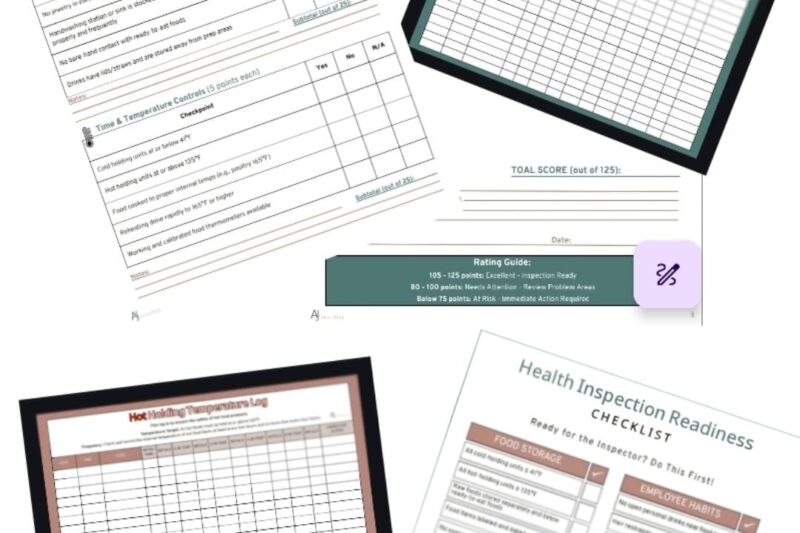
– Pre-audit readiness checklist for HACCP, ISO 22000, and FSSC 22000
– Auditor selection guide with contact points for 15 major certification bodies
– Timeline planner template (Gantt chart) for your certification journey
[📥 Download the Food Safety Certification Decision Tool (Free PDF) →] (Link to be enabledemail sign-up required)
#
About the Author
Prashant Chavhan is a food industry consultant and the founder of FoodTechPro.co.in. He helps Indian food businesses navigate FSSAI compliance, food safety certification, and operational excellence. With over a decade of experience in the Indian food processing sector, Prashant has advised 50+ food businesses on certification strategyfrom small spice processors in Gujarat to large export-oriented seafood units in Kerala.
Disclaimer: The cost figures in this article are indicative estimates based on market research and industry reports. Actual costs vary based on site complexity, certification body, location, and scope. Contact multiple certification bodies for accurate quotes. This information is for educational purposes and does not constitute legal or compliance advice.
#
Sources & References
– Codex AlimentariusHACCP Principles and Guidelines (CAC/RCP 1-1969, Rev. 2020)
– ISO 22000:2018 Food Safety Management SystemsRequirements
– FSSC 22000 Scheme Version 6.0Foundation for Food Safety Certification
– FSSAI Licensing and Registration Regulations, 2011 (Amended 2026)Schedule 4
– Global Food Safety Initiative (GFSI)Benchmarking Requirements
– APEDA / MPEDA Export Certification Requirements for Indian Food Processors
– FSSAI Annual Report 2024–25Food Safety Certification Data
– Industry interviews with certification bodies in India (SGS, Bureau Veritas, BSI, TÜV SÜD)
– DGFT (Directorate General of Foreign Trade)Export Policy for Processed Foods

Prashant Chavhan
Expert writer covering food technology, food safety, and industry innovations.