FSSAI License in India: The Complete 2026 Guide for Food Businesses
Author: Prashant Chavhan | Last Updated: 25 June 2026
Introduction
Every 11 minutes, an Indian food business receives an FSSAI show-cause notice. Most didn’t know they were non-compliant. With the sweeping 2026 Amendment now in effect, ignorance is no longer a defence.
The FSSAI Licensing and Registration Amendment Regulations 2026, effective from 1 April 2026, introduced the most significant changes in a decade: perpetual license validity, new turnover thresholds (registration up to ₹1.5 crore, state licence from ₹1.5–20 crore, central licence above ₹20 crore), deemed registration for street vendors, and risk-based inspections. On top of that, the Labelling & Display First Amendment 2026 tightened rules on nutrition declarations, health claims, allergen labelling, and front-of-pack warnings.
Here’s what this guide covers: the exact 3-tier FSSAI licensing system and which one applies to you, the complete 2026 labelling requirements with a checklist, the 7 most common inspection triggers and how to prepare, the penalty structure for non-compliance (including the new higher fines), the step-by-step FoSCoS online application process, the documentation requirements for each business type, the food recall procedure, allergen management obligations, and a complete compliance roadmap. Plus, download our free FSSAI Compliance Checklist PDF to audit your business in under 30 minutes.
This guide is built on the official FSSAI regulations as gazetted, the FoSCoS portal documentation, FSSAI’s own inspection matrices and compliance checklists, industry advisories, and expert commentary from food compliance professionals across India. It reflects the most current regulatory position as of June 2026, including the latest amendments to the Licensing and Registration Regulations (2026) and Labelling & Display Regulations (First Amendment 2026).
FSSAI compliance in 2026 is no longer a simple checkbox exerciseit’s a strategic advantage. The new perpetual license, simplified registration for small businesses, and risk-based inspection system reward proactive compliance. Get it right, and you save time, avoid penalties, and build consumer trust. Get it wrong, and the penaltiesnow up to ₹5 lakh per offencecan cripple your business.
Table of Contents
1. [Understanding FSSAI: The Regulatory Framework](#understanding-fssai)
2. [The 2026 Amendment: What Changed and Why It Matters](#2026-amendment)
3. [FSSAI License Types: Which One Do You Need?](#license-types)
4. [Step-by-Step FSSAI License Application Process (FoSCoS)](#application-process)
5. [FSSAI License Documentation Checklist](#documentation-checklist)
6. [FSSAI Fee Structure 2026 (Complete Breakdown)](#fee-structure)
7. [FSSAI Labeling Compliance: The 2026 Rules](#labeling-compliance)
8. [FSSAI Product Approval and Standards](#product-approval)
9. [FSSAI Inspection: What to Expect and How to Prepare](#inspection)
10. [FSSAI Enforcement: Penalties and Consequences](#enforcement)
11. [FSSAI Food Recall Procedure](#food-recall)
12. [FSSAI for Specific Business Types](#business-types)
13. [FSSAI Compliance for Food Testing and Labs](#food-testing)
14. [FSSAI Annual Return and Compliance Filings](#annual-return)
15. [FSSAI and Food Safety Management Systems](#food-safety-management)
16. [Common FSSAI Compliance Mistakes and How to Avoid Them](#common-mistakes)
17. [Your 30-Day FSSAI Compliance Action Plan](#action-plan)
1. Understanding FSSAI: The Regulatory Framework
1.1 What is FSSAI and What Does It Do?
The Food Safety and Standards Authority of India (FSSAI) is the apex statutory body established under the Food Safety and Standards Act, 2006. Headquartered in New Delhi, FSSAI is responsible for protecting and promoting public health through the regulation and supervision of food safety across India. It lays down science-based standards for food products, regulates manufacturing, storage, distribution, sale, and import, and monitors compliance through a network of state food safety authorities.
According to FSSAI’s official mandate ([fssai.gov.in](https://www.fssai.gov.in)), the authority frames regulations on food safety standards, product approval, packaging and labelling, food additives, contaminants, and residues. It also advises the central and state governments on food safety and nutrition policy.
1.2 The Legal Foundation: Food Safety and Standards Act, 2006
The Food Safety and Standards Act, 2006 (FSS Act) consolidated multiple central acts and state orders related to food safety into a single, comprehensive law. Prior to this, India’s food regulatory framework was fragmented across the Prevention of Food Adulteration Act, 1954, the Fruit Products Order, 1955, the Meat Food Products Order, 1973, and several other regulations. The FSS Act repealed all these through its Section 97, creating one unified reference point for food regulation.
The Act empowers FSSAI to:
– Frame food safety standards and regulations
– Approve food products and licenses
– Conduct inspections and collect food samples
– Prosecute violators through a designated adjudication mechanism
– Issue food safety notices and public alerts
1.3 Key Regulations Governing Food Businesses
Food business operators (FBOs) must comply with several key regulations framed under the FSS Act. The most important include:
– FSSAI Licensing and Registration Regulations, 2011 (amended 2026)governs the licensing framework and compliance obligations
– FSSAI Labelling and Display Regulations, 2020 (First Amendment 2026)mandates labelling requirements for all packaged food
– FSSAI Food Product Standards and Food Additives Regulations, 2011defines food standards and additive limits
– FSSAI Prohibition and Restriction on Sales Regulations, 2011covers conditions for sale of specific food categories
– FSSAI Contaminants, Toxins and Residues Regulations, 2011sets limits for heavy metals, pesticide residues, and contaminants
1.4 FSSAI’s Relationship with State FDAs and Other Bodies
FSSAI works closely with State Food Safety Departments and State Food Safety Commissioners to implement food safety laws across India. State Food and Drug Administration (FDA) departments handle licensing for state-level FBOs, while FSSAI’s central office manages central licenses, imports, and exports. The authority also coordinates with the Bureau of Indian Standards (BIS), the Agricultural and Processed Food Products Export Development Authority (APEDA), the Ministry of Health and Family Welfare, and the World Health Organization (WHO) on standard-setting and food safety initiatives.
2. The 2026 Amendment: What Changed and Why It Matters
The FSSAI Licensing and Registration Amendment Regulations, 2026, notified in March 2026 and effective from 1 April 2026, represent the most substantial overhaul of India’s food licensing regime in over a decade. Here’s what every food business must know.
2.1 Perpetual License ValidityThe Biggest Change
The single most impactful change in the 2026 Amendment is the introduction of perpetual (lifetime) license validity. Previously, FSSAI licenses were valid for 1 to 5 years and required periodic renewal with fresh fee payments and documentation. Under the new regime, once granted, a license remains valid indefinitelyprovided the business maintains compliance and files annual returns.
This reduces the administrative burden on FBOs significantly. However, the license is subject to suspension or cancellation for non-compliance, so the “perpetual” nature is conditional on continued adherence to regulatory requirements.
2.2 New Turnover Thresholds (Registration, State, Central)
The 2026 Amendment revised the turnover thresholds that determine which tier of license a business requires. The updated thresholds are:
| License Category | Previous Threshold | New Threshold (2026) |
|---|---|---|
| Basic Registration | Up to ₹12 lakh | Up to ₹1.5 crore |
| State License | ₹12 lakh – ₹20 crore | ₹1.5 crore – ₹20 crore |
This is a major relief for small businesses. FBOs with annual turnover up to ₹1.5 crore now qualify for basic registration instead of needing a state license, reducing both cost and compliance burden.
2.3 Deemed Registration for Street Food Vendors
The 2026 Amendment introduced deemed registration for street food vendors covered under the PM Street Vendor’s AtmaNirbhar Nidhi (PM SVANidhi) scheme. These vendors are automatically considered registered with FSSAI without filing a separate application. This single reform brings millions of informal food vendors into the formal regulatory net, improving public health oversight.
2.4 Risk-Based Inspection Framework
The amendment replaced the previous uniform inspection system with a risk-based inspection framework. Businesses are now categorised into risk tiers (low, medium, high) based on factors including:
– Nature of food product (high-risk categories like dairy, meat, and prepared foods face more frequent inspections)
– Business scale and turnover
– Past compliance history
– Previous violations or adverse sampling results
High-risk businesses face inspections at least once in two years, while low-risk businesses may be inspected less frequently. The scoring matrix aligns with international best practices recommended by Codex Alimentarius.
2.5 Revised Penalties and Enforcement Powers
The 2026 Amendment enhanced FSSAI’s enforcement powers. Key changes include:
– Increased per-offence penalties (now up to ₹5 lakh per offence, up from ₹2 lakh)
– Daily fines for continuing non-compliance (up to ₹20,000 per day)
– Expanded powers for Food Safety Commissioners to issue interim safety orders
– Authority to publish names of non-compliant businesses on the FSSAI website
3. FSSAI License Types: Which One Do You Need?
Choosing the correct license category is the foundation of FSSAI compliance. Errors here cause application delays and potential rejection. Here’s how the three-tier system works in 2026.
3.1 Basic Registration (Turnover ≤ ₹1.5 Crore)
If your business has an annual turnover of up to ₹1.5 crore, you qualify for basic FSSAI registration. This applies to petty food manufacturers, small retailers, hawkers, temporary stall holders, small-scale cottage industries, home-based food businesses, and small distributors.
Registration is done through Form A on the FoSCoS portal. The registration fee is nil (free) for petty FBOs. The registration certificate (Form A certificate) still requires periodic renewal.
Who needs basic registration:
– Small retailers and grocery stores
– Home bakers and cloud kitchens with turnover under ₹1.5 crore
– Street food vendors (also eligible for deemed registration)
– Petty manufacturers producing under 100 litres/litres per day of certain products
– Small distributors and transporters
3.2 State License (₹1.5 Crore – ₹20 Crore Turnover)
Food businesses with annual turnover between ₹1.5 crore and ₹20 crore require a state license from the respective State Food Safety Department. This covers mid-sized manufacturers, large retailers, restaurants, hotels, caterers, and distributors operating within a single state.
Applications are filed through Form B on FoSCoS. The annual fee ranges from ₹2,000 to ₹5,000 per year depending on the business category. With perpetual license validity, this is now a one-time fee (excluding periodic certificate renewal).
Who needs a state license:
– Mid-sized food manufacturers
– Restaurants, hotels, and caterers exceeding ₹1.5 crore turnover
– Repackers and relabellers
– Wholesale distributors
– Medium-scale transporters
– Storage facilities (cold storage, warehouses)
3.3 Central License (Turnover > ₹20 Crore / Multi-State Operations)
Businesses with annual turnover exceeding ₹20 crore, or those operating in multiple states, require a central license issued directly by the FSSAI headquarters in New Delhi. This category covers India’s largest food businesses, including national brands, large manufacturers, and corporations.
The central license fee ranges from ₹6,000 to ₹7,500 per year. Additional documentation requirements include a comprehensive food safety management plan, third-party audit reports, and detailed product specifications.
Who needs a central license:
– Large-scale manufacturers and processors exceeding ₹20 crore turnover
– Businesses operating in two or more states
– Food importers (regardless of turnover)
– Food exporters (for certain categories)
– E-commerce food platforms and aggregators
– Caterers servicing railways, airlines, and ships
– Businesses supplying to the armed forces
– Food storage units with capacity exceeding 50,000 MT
3.4 Special Categories: Exporters, Importers, E-Commerce Operators
Certain business types require a central license regardless of turnover:
– Importers: All food importers must hold a central license, as food imports fall under FSSAI’s direct jurisdiction. Import clearance requires additional compliance with the Food Import Clearance System.
– Exporters: While most exporters can operate under a state license, those exporting to countries with specific import requirements (e.g., the EU, US) may need additional certifications.
– E-commerce operators: Online food marketplaces, aggregators, and delivery platforms require a central license. Individual sellers on these platforms must hold their own FSSAI registration or license.
– Food storage operators: Warehouses and cold storage units handling >50,000 MT require central licenses.
For a detailed breakdown of fees by license type, see our guide on [FSSAI License Fees 2026](/fssai-license-fees/).
4. Step-by-Step FSSAI License Application Process (FoSCoS)
The Food Safety Compliance System (FoSCoS) is FSSAI’s online portal for all licensing and registration activities. Introduced in 2021 as a replacement for the older FLRS (Food Licensing and Registration System), FoSCoS provides a streamlined digital interface for applications, renewals, modifications, and annual return filings.
4.1 Online Registration on the FoSCoS Portal
Step 1: Visit the FoSCoS portal at [foscos.fssai.gov.in](https://foscos.fssai.gov.in) and click “Register as New User.”
Step 2: Select your business category (manufacturer, processor, repacker, storage, distributor, transporter, retailer, caterer, or importer/exporter).
Step 3: Choose the appropriate form:
– Form A for Basic Registration (turnover up to ₹1.5 crore)
– Form B for State or Central License (turnover above ₹1.5 crore)
Step 4: Fill in business details including name, address, contact information, PAN, GSTIN, Aadhaar of proprietor/partners/directors, food category (as per FSSAI’s product list), annual turnover estimate, and premises details.
Step 5: Upload the required documents.
Step 6: Pay the applicable fee online (for Form B applications).
Step 7: Submit the application and note your application reference number.
4.2 Document Preparation and Upload
Prepare all documents in scanned PDF format (each file under 2 MB). FSSAI accepts documents in English or Hindi. List of required documents by category is provided in [Section 5](#documentation-checklist).
Pro tip: Keep all documents in a single folder organised by category. Uploading incorrect or blurry documents is the #1 reason for application rejection.
4.3 Fee Payment (2026 Fee Schedule)
Payment is made online through the FoSCoS portal via net banking, credit/debit card, or UPI. Refer to [Section 6](#fee-structure) for the complete 2026 fee schedule.
4.4 Inspection and Approval Timeline
After submission, the application is processed as follows:
| Step | Timeline | Details |
|---|---|---|
| Document verification | 3–7 days | The designated officer reviews uploaded documents |
| Inspection (if applicable) | 7–30 days | Manufacturing units and certain high-risk categories require a physical inspection of the premises |
| Approval/rejection decision | 30–60 days total | FSSAI is required to process applications within 60 days |
Note: Basic registration (Form A) for non-manufacturing businesses is typically processed faster, often within 7–15 days, as physical inspection may not be required. Central license applications for importers and multi-state operators generally take the full 60-day window.
4.5 Post-Approval: Downloading and Displaying Your License
Once approved, you can download your FSSAI license certificate from the FoSCoS dashboard. The certificate includes:
– FSSAI license number (14-digit alphanumeric)
– Business name and address
– License category (Registration/State/Central)
– Product categories approved
– Validity (perpetual post-2026 Amendment)
For a detailed walkthrough with screenshots, see our guide: [How to Get FSSAI License in India (Step-by-Step)](/fssai-license-step-by-step/).
5. FSSAI License Documentation Checklist
A complete and correctly formatted document set is critical for swift application processing. Below is the document checklist by license type.
5.1 Documents for Basic Registration (Form A)
| Document | Requirement |
|---|---|
| Identity proof | Aadhaar card, Voter ID, or PAN card of the proprietor |
| Business address proof | Recent utility bill, rent agreement, or property tax receipt |
| Passport-size photograph | Proprietor/partner/director |
| PAN card | Of the business entity or proprietor |
For petty manufacturers: additional declaration of production capacity.
5.2 Documents for State License (Form B)
| Document | Requirement |
|---|---|
| Identity proof | Aadhaar and PAN of all partners/directors |
| Business registration proof | GST certificate, incorporation certificate, or partnership deed |
| Premises document | Address proof, layout plan, NOC from municipality (where applicable) |
| Food safety management plan | Documented FSMS as per Schedule IV of FSSAI regulations |
| List of food products | Categories as per FSSAI’s list |
| Equipment list | Details of machinery and equipment installed |
| Water quality report | From an FSSAI-notified or NABL-accredited lab |
| Authority letter | If filed through a consultant (Form IX) |
5.3 Documents for Central License (Form B)
All documents listed for state license, plus:
| Document | Requirement |
|---|---|
| Turnover certificate | CA-certified or audited balance sheet / GST returns |
| Import-export code (IEC) | For importers and exporters |
| Board resolution | For companiesauthorising the application |
| Third-party audit report | For certain high-risk categories |
| Product approval certificates | For proprietary foods, nutraceuticals, health supplements |
| Recall plan | Documented product recall procedure |
5.4 Additional Documents for Specific Business Types
– Clarification of water testing reports: Manufacturers must provide recent (within 6 months) water quality test reports from a recognised laboratory.
– Waste disposal system: Business with significant waste must submit a waste management plan.
– Transporters: Vehicle registration documents, transportation agreements, and cleaning procedures.
– Storage facilities: Capacity details, temperature logs, pest control records.
– E-commerce operators: Platform details, seller agreements, quality assurance policy.
> 📥 Free Download: [Get the Complete FSSAI Compliance Checklist PDF](/fssai-compliance-checklist-pdf/)A 28-point audit checklist covering licensing, labeling, hygiene, documentation, and inspection readiness. Use it to assess your business in under 30 minutes.
6. FSSAI Fee Structure 2026 (Complete Breakdown)
Understanding the fee structure is essential for budgeting your compliance costs. Here is the complete fee schedule under the 2026 Amendment.
6.1 Registration Fee (NilFree for Petty FBOs)
Basic registration under Form A is free of charge for petty food business operators. This is unchanged from the pre-2026 regime and continues to provide a zero-cost entry point for small businesses.
6.2 State License Fee Schedule
For Form B (State License), the annual fee is calculated based on business type:
| Business Type | Annual Fee (₹) |
|---|---|
| Manufacturer | ₹5,000 |
| Processor | ₹5,000 |
| Repacker / Relabeller | ₹5,000 |
| Wholesale distributor | ₹3,000 |
| Retailer (single/multi-outlet) | ₹2,000 |
| Restaurant / Hotel / Caterer | ₹2,000 |
| Distributor | ₹3,000 |
| Transporter | ₹2,000 |
| Storage / Cold storage | ₹3,000 |
Note: Since the 2026 Amendment introduced perpetual validity, these fees are generally applicable as a one-time payment (though the registration certificate on Form A still requires periodic renewal).
6.3 Central License Fee Schedule
| Business Type | Annual Fee (₹) |
|---|---|
| Manufacturer (above ₹20 crore turnover) | ₹7,500 |
| Importer | ₹7,500 |
| Multi-state operator | ₹7,500 |
| E-commerce platform / aggregator | ₹7,500 |
| Caterer (railways/airlines) | ₹7,500 |
| Large storage facility (>50,000 MT) | ₹6,000 |
6.4 License Modification, Duplicate, and Renewal Fees
| Service | Fee (₹) |
|---|---|
| Modification of license (change in business details) | ₹1,000 |
| Duplicate license certificate | ₹500 |
Important: With perpetual validity under the 2026 Amendment, the “renewal fee” concept applies only to the registration certificate (Form A). License holders (Form B) maintain perpetual validity through annual return filings rather than periodic renewal fees.
7. FSSAI Labeling Compliance: The 2026 Rules
Labelling compliance is the area where most FBOs face compliance issues. The FSSAI Labelling and Display First Amendment 2026 introduced significant changes that every food business must implement immediately.
7.1 Mandatory Label Elements (Name, Ingredients, Nutrition, etc.)
Every packaged food product must display the following information on its label:
1. Name of the foodThe proper name or customary name of the product
2. List of ingredientsIn descending order of weight
3. Nutritional informationPer 100g/ml format (see 7.2)
4. FSSAI logo and license numberMandatory display
5. Veg/Non-Veg logoGreen dot for vegetarian, brown dot for non-vegetarian
6. Net quantityWeight, volume, or number
7. Manufacturer’s name and addressComplete registered office address
8. Date of manufacture and best-before dateSee 7.6
9. Batch/Lot numberFor traceability
10. Country of originFor imported products
11. Allergen declarationSee 7.3
12. Instructions for useFor products requiring specific handling
7.2 Nutritional Information Requirements (Per 100g/ml Format)
The 2026 Amendment standardised the nutritional information format. Every label must display values per 100g (for solids) or per 100ml (for liquids), including:
– Energy (kcal)
– Protein (g)
– Carbohydrate (g)with sub-declaration of total sugars, added sugars
– Total fat (g)with sub-declaration of saturated fat, trans fat, cholesterol
– Dietary fibre (g)
– Sodium (mg)
Values may also be shown per serving portion, but the 100g/ml format is mandatory. The declaration must be in an easy-to-read tabular format.
7.3 Allergen Declaration: The 9 Mandatory Allergens
The 2026 labelling amendment requires mandatory declaration of nine allergens:
1. Cereals containing gluten (wheat, rye, barley, oats)
2. Crustaceans and their products
3. Eggs and egg products
4. Fish and fish products
5. Peanuts and peanut products
6. Soybeans and soybean products
7. Milk and milk products (including lactose)
8. Tree nuts (almonds, cashews, walnuts, etc.)
9. Sulphites in concentrations of 10 mg/kg or more
The allergen declaration must appear immediately after the ingredient list, in a distinct font or format (bold, capitalised, or highlighted box).
7.4 FSSAI Logo and License Number Display Rules
The FSSAI logo must be printed clearly on the principal display panel. Below the logo, the 14-digit license number must be displayed in the format: FSSAI License No. [Number]. The license number must be clearly legible and placed on any of these panels:
– Front label (principal display panel)
– Back label (if clearly visible upon purchase)
– Side panel
Failure to display the FSSAI logo and license number on packaging is one of the most commonly cited violations.
7.5 Veg/Non-Veg Logo (Green/Brown Dot) Requirements
The vegetarian (green dot) and non-vegetarian (brown dot) logos must be displayed prominently on the front label. The logo consists of a green or brown-filled circle inside a square border. The dimensions must be proportionate to the package size:
– For packages up to 100 sq. cm: minimum 6 mm diameter
– For packages 100–500 sq. cm: minimum 10 mm diameter
– For packages above 500 sq. cm: minimum 14 mm diameter
7.6 Date Marking: Manufacturing, Best Before, Expiry
Every package must display:
– Date of manufactureThe date the product was manufactured
– Best-before dateThe date until which the product retains its specific properties under proper storage
– Use-by dateFor highly perishable foods (e.g., fresh milk, meat): product should not be consumed after this date
Dates should be in the format DD/MM/YYYY and placed on the label where they are easily visible.
7.7 Health Claims and Nutraceutical Label Rules
Health claims on food products are strictly regulated. Under the 2026 Amendment:
– Nutrition claims (e.g., “low fat,” “high fibre”) must meet the specific compositional criteria defined by FSSAI
– Health claims (e.g., “supports immunity,” “aids digestion”) require scientific substantiation and prior approval
– Nutraceuticals and Health Supplements must follow the FSSAI Nutraceutical Regulations, 2022, with specific label declarations
– Functional foods and foods for special dietary use have additional labelling requirements
7.8 Front-of-Pack Labelling (FOPL)The New Warning System
The 2026 Labelling Amendment introduced Front-of-Pack Labelling (FOPL)a new warning system for packaged foods high in fat, sugar, and salt (HFSS). Key features:
– Products exceeding threshold levels for total fat, saturated fat, trans fat, sugar, and sodium must display a red warning label on the front panel
– The warning label uses a standardised format: a red octagon (stop sign shape) with “High in [Sugar/Fat/Salt]” in white text
– The thresholds align with WHO-recommended nutrient profile models
– This applies to all packaged foods including imported products
Implementation timeline: The FOPL requirement was phased in from April 2026, with full compliance expected within 12 months for most categories.
For a comprehensive guide, see: [FSSAI Labeling Requirements 2026: Complete Guide](/fssai-labeling-requirements/).
8. FSSAI Product Approval and Standards
8.1 Proprietary Food Approval Process
Proprietary foods (products with novel formulations not covered by existing FSSAI standards) require product approval before they can be marketed. The process involves:
– Submission of product formulation and specification
– Safety data and scientific evidence
– Nutritional composition analysis
– Compliance with FSSAI’s proprietary food standards
The approval timeline is typically 3–6 months. Products marketed without approval are considered non-compliant and subject to penalties.
8.2 Food Additive Regulations (Permitted List and Limits)
FSSAI regulates food additives based on the Codex Alimentarius framework. Only additives from the permitted list can be used, and only within the specified maximum limits for each food category. Key categories include:
– Preservatives (benzoates, sorbates, sulphites)
– Colours (permitted natural and synthetic colours with limits)
– Flavours (natural, nature-identical, and artificial)
– Sweeteners (permitted artificial sweeteners with ADI limits)
– Emulsifiers, stabilisers, thickeners, and gelling agents
8.3 Contaminant, Toxin, and Residue Limits
FSSAI regulations specify maximum limits for:
– Heavy metals: Lead, cadmium, mercury, arsenic, tin
– Pesticide residues: As per the Food Safety and Standards (Contaminants, Toxins and Residues) Regulations, 2011
– Mycotoxins: Aflatoxins, ochratoxin A, patulin, deoxynivalenol
– Veterinary drug residues: Antibiotics, growth promoters
– Microbiological limits: Salmonella, Listeria, E. coli, Yeast and Mould counts
Businesses must ensure regular testing of raw materials and finished products to comply with these limits.
8.4 Fortification Standards and Logo Requirements
The Food Safety and Standards (Fortification of Foods) Regulations, 2018 govern the addition of micronutrients to staple foods. FSSAI’s +F logo indicates fortified products. Key requirements:
– Only specified foods can be fortified (wheat flour, rice, milk, edible oil, salt, and double-fortified salt)
– Minimum and maximum fortification levels are prescribed for each nutrient
– The +F logo must be displayed on the label along with the tagline “Sampoorna Poshan”
– Fortified products must also include nutritional information specific to fortification
9. FSSAI Inspection: What to Expect and How to Prepare
FSSAI inspections can be anxiety-inducing for business owners, but proper preparation makes them routine. Here’s what to expect under the new 2026 framework.
9.1 Types of Inspections (Routine, Complaint-Based, Surveillance)
FSSAI conducts three types of inspections:
1. Routine inspections: Scheduled inspections based on the risk profile of the business. High-risk businesses (dairy, meat, prepared foods) are prioritised. Under the 2026 risk-based framework, inspection frequency is determined by a scoring system.
2. Complaint-based inspections: Triggered by consumer complaints, competitor reports, media reports, or NGO alerts. These are typically unannounced.
3. Surveillance inspections: Random checks to monitor ongoing compliance, often focusing on specific product categories or geographic areas.
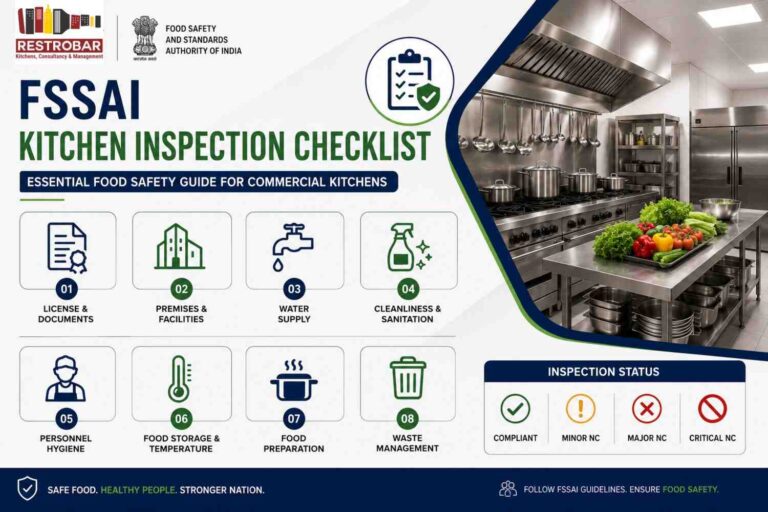
9.2 The Schedule IV Compliance Checklist
Schedule IV of the FSSAI Licensing and Registration Regulations details the hygienic and sanitary practices that every food business must follow. This is the primary checklist inspectors use. Key requirements include:
Premises and facilities:
– Clean, pest-proof, and well-ventilated premises
– Adequate drainage and waste disposal systems
– Potable water supply with documented testing
– Separate areas for raw and cooked food handling
Personnel:
– Clean clothing, headgear, and footwear
– Medical fitness certificates for food handlers
– No open cuts, wounds, or infections among staff
– Training records for food safety practices
Processing and storage:
– Proper temperature control (hot holding above 63°C, cold storage below 5°C)
– FIFO (first-in, first-out) stock rotation
– Segregation of raw, processed, and waste materials
– Pest control records and bait station maps
Documentation:
– FSMS records as per business size
– Supplier audit reports and raw material test certificates
– Cleaning and sanitation logs
– Training records
9.3 The Risk-Based Inspection Scoring System
FSSAI’s new risk-based scoring system categorises businesses on a point scale:
– Score 0–30: Low riskInspection once every 3–5 years
– Score 31–60: Medium riskInspection once every 2 years
– Score 61–100: High riskInspection annually or more frequently
Factors affecting the score include: food category risk level, annual turnover, business size, past compliance history, and food safety certifications held.
9.4 Common Findings That Lead to Show-Cause Notices
According to FSSAI’s compliance data, the most common inspection findings include:
– Missing or expired FSSAI license display
– No FSMS documentation or inadequate records
– Pest infestation or inadequate pest control measures
– Poor personal hygiene practices among food handlers
– Improper waste disposal
– Cross-contamination risks (raw/cooked materials not segregated)
– Temperature abuse in cold storage or hot holding
– Mislabelled or unlabelled products
For a comprehensive inspection preparation guide, see: [FSSAI Inspection Preparation Guide](/fssai-inspection-preparation/).
10. FSSAI Enforcement: Penalties and Consequences
10.1 Penalty Structure 2026 (Per Offence and Daily Fines)
The 2026 Amendment substantially increased penalties for non-compliance:
| Offence | Maximum Penalty (₹) |
|---|---|
| Selling food not of the nature or substance demanded | ₹3 lakh |
| Substandard food | ₹3 lakh |
| Misbranded food | ₹3 lakh |
| Misleading advertisement or false description | ₹5 lakh |
| Food containing extraneous matter | ₹3 lakh |
| Unsafe or adulterated food (non-injurious) | ₹5 lakh |
| Unsafe or adulterated food (injurious) | ₹10 lakh + imprisonment |
| Operating without license | ₹5 lakh |
Repeat offences within 3 years attract double the penalty plus potential license cancellation.
10.2 Show-Cause Notices: How to Respond
If you receive an FSSAI show-cause notice:
1. Read carefullyUnderstand the specific violation cited, including the legal provision allegedly contravened
2. Note the deadlineResponses must typically be submitted within 15–30 days
3. Gather evidenceCollect compliance documentation, test reports, photographs, purchase records, and any other evidence demonstrating compliance
4. Submit a written responseAcknowledge the notice, present your case with supporting documents, and propose corrective actions if applicable
5. Seek professional adviceConsult an FSSAI compliance consultant or food law attorney for complex cases
10.3 Adjudication Process and Appeals
Adjudication follows a defined hierarchy:
1. Designated Officer (DO): Issues the initial notice and may impose penalties after hearing the FBO
2. Adjudicating Officer: Appointed by the Food Safety Commissioner; conducts formal hearings
3. Food Safety Appellate Tribunal: Hears appeals against adjudication orders
4. High Court: The final appellate authority
10.4 License Suspension and Cancellation
FSSAI may suspend or cancel a license for:
– Repeated or serious non-compliance
– Failure to comply with improvement notices
– Conviction for an offence under the FSS Act
– False statements in the application
– Failure to file annual returns
Suspension is typically temporary (30–90 days), allowing the business to rectify the issue. Cancellation is permanent and requires a fresh application after a cooling-off period.
For detailed information: [FSSAI Penalties 2026: Complete Breakdown](/fssai-penalties/).
11. FSSAI Food Recall Procedure
11.1 When a Recall is Mandatory
A food recall is mandatory when a product is found to be:
– Unsafe or injurious to health
– Contaminated with pathogens (Salmonella, Listeria, E. coli, etc.)
– Containing undeclared allergens
– Misbranded in a way that poses a health risk
– Non-compliant with FSSAI standards in a manner affecting consumer safety
The FBO must initiate the recall within 24 hours of becoming aware of the issue.
11.2 Recall Plan Requirements
Every FSSAI license holder (state and central) must have a documented recall plan covering:
– Roles and responsibilities of the recall team
– Procedures for identifying and segregating affected stock
– Communication protocols (internal and external)
– Distribution records enabling traceability
– Disposal procedures for recalled products
– Root cause analysis framework
11.3 Step-by-Step Recall Execution
1. Initiate recallNotify FSSAI’s Recall Office immediately
2. Identify affected stockTrace all lots/batches affected; segregate from saleable stock
3. CommunicationNotify distributors, retailers, and consumers (via public notice and social media)
4. Collect productsArrange for collection from all supply chain points
5. Dispose or reworkDestroy the product or rework it under FSSAI supervision (if permitted)
6. Submit recall reportFile a detailed report with FSSAI within the specified period
7. Root cause analysisIdentify the cause and implement corrective measures
11.4 Recall Communication and Public Notification
Public notification must include:
– Product name, brand, batch/lot number, and date codes
– Reason for recall and associated health risk
– Instructions for consumers (stop consumption, return for refund)
– Contact information for the FBO
12. FSSAI for Specific Business Types
12.1 FSSAI for Home-Based Food Businesses
Home-based food businesses (home bakers, caterers, pickle manufacturers, etc.) fall under Basic Registration (Form A) if turnover is under ₹1.5 crore. Key requirements:
– The home kitchen must meet basic hygiene standards (Schedule IV)
– Separate area for food preparation (not shared with family cooking ideally)
– FSSAI license number on all packaging
– Home-based businesses are eligible for the license fee waiver (petty FBO category)
See our dedicated guide: [FSSAI for Home-Based Food Businesses](/fssai-home-business/).
12.2 FSSAI for Cloud Kitchens
Cloud kitchens (also called ghost kitchens or dark kitchens) operate under specific regulations:
– Registration or license based on turnover (same 3-tier system applies)
– Central license required if operating in multiple cities or states
– Each kitchen unit requires a separate FSSAI registration
– Third-party delivery partners must be disclosed
– Proper packaging and labelling with FSSAI license number
– Compliance with Schedule IV hygiene standards
See: [FSSAI for Cloud Kitchens: Complete Compliance Guide](/fssai-cloud-kitchens/).
12.3 FSSAI for E-Commerce Food Sellers
E-commerce food sellers (on platforms like Amazon, Flipkart, Swiggy, Zomato, Zepto, Blinkit, BigBasket) must:
– Hold an FSSAI license (state or central based on turnover)
– Display the FSSAI license number on all product pages
– Ensure all listed products comply with FSSAI labelling standards
– Maintain traceability records for recalled products
– Platforms have a separate obligation to verify sellers’ FSSAI compliance
See: [FSSAI for E-Commerce Food Sellers](/fssai-ecommerce/).
12.4 FSSAI for Food Exporters
Food exporters require:
– Central license (mandatory for certain categories)
– Compliance with the importing country’s food safety standards (which may exceed FSSAI requirements)
– Certificate of free sale (CFS) from FSSAI
– Export inspection reports from Export Inspection Council (EIC)
– FSSAI’s Export NOC for certain categories
– Compliance with CODEX, USFDA, EU, or other international standards as applicable
See: [FSSAI for Exporters: Special Requirements](/fssai-exporters/).
12.5 FSSAI for Imported Food
All food imported into India must:
– Have a central FSSAI license
– Pass through FSSAI’s Food Import Clearance System
– Be sampled and tested at the port of entry
– Comply with Indian food standards (equivalent standards are accepted for certain parameters)
– Bear labels compliant with FSSAI’s Labelling Regulations (including importer details, FSSAI logo, and Indian address)
13. FSSAI Compliance for Food Testing and Labs
13.1 NABL Accreditation Requirements
Food testing laboratories seeking FSSAI recognition must hold NABL (National Accreditation Board for Testing and Calibration Laboratories) accreditation. NABL accreditation ensures:
– Competence of laboratory personnel
– Validity of testing methods
– Proper equipment calibration and maintenance
– Quality assurance procedures (ISO/IEC 17025 compliance)
13.2 Sample Collection and Sealing Procedures
FSSAI food inspectors follow standardised sampling procedures:
– Samples are collected in triplicate (one for the FBO, one for the lab, one for the authority)
– Each sample is sealed with the FSSAI’s official seal
– The FBO’s representative signs the sample seals
– Samples are transported in proper conditions (cold chain for perishables)
– Testing is conducted at an FSSAI-notified laboratory
13.3 Recognized Testing Parameters
FSSAI-notified labs test for:
– Nutritional composition (proximates, vitamins, minerals)
– Food additives (preservatives, colours, sweeteners)
– Contaminants (heavy metals, pesticide residues, mycotoxins)
– Microbiological parameters (pathogens, indicator organisms)
– Adulteration (specific tests for common adulterants in milk, spices, pulses, etc.)
– Authenticity (species identification, botanical origin)
14. FSSAI Annual Return and Compliance Filings
14.1 Who Must File the Annual Return
All FBOs holding a state or central license (Form B) must file an annual return with FSSAI. Basic registration holders (Form A) are currently exempt from the annual return requirement.
The return covers the financial year (April–March) and is filed through the FoSCoS portal.
14.2 Return Format and Deadline
The annual return includes:
– Business name and license details
– Total turnover for the financial year
– Quantity of food products manufactured/processed/handled
– Compliance status with Schedule IV standards
– Details of any enforcement actions or recalls during the year
Deadline: The annual return must be filed by 30 June of the following financial year (e.g., return for FY 2025–26 is due by 30 June 2026).
14.3 Consequences of Non-Filing
Failure to file the annual return can result in:
– Late fee penalties (as prescribed by FSSAI from time to time)
– License suspension (for persistent non-filing)
– Ineligibility for license modifications or renewals
– Negative marking in the risk-based inspection scoring system
For complete guidance: [FSSAI Renewal and Annual Return Guide](/fssai-renewal-annual-return/).
15. FSSAI and Food Safety Management Systems
15.1 GMP/GHP Requirements Under FSSAI
Every FSSAI-licensed business must implement Good Manufacturing Practices (GMP) and Good Hygiene Practices (GHP) as outlined in Schedule IV of the regulations. These cover:
– Design and facilities of food premises
– Control of operations (raw material, processing, packaging)
– Maintenance and sanitation procedures
– Personal hygiene standards
– Transportation and storage conditions
– Product information and consumer awareness
– Training of food handlers
15.2 HACCP and ISO 22000 Relationship with FSSAI
While not mandatory for all FBOs, implementing a formal food safety management system (FSMS) provides significant advantages:
– HACCP (Hazard Analysis Critical Control Point): Required for certain high-risk categories; strongly recommended for all manufacturers
– ISO 22000:2018: International FSMS standard that integrates HACCP principles with management system requirements
– FSSC 22000: GFSI-benchmarked certification scheme widely accepted internationally
FSSAI’s recognition of third-party certification reduces inspection frequency under the risk-based framework.
15.3 FSSAI’s Recognition of Third-Party Audits
Under the 2026 Amendment, FSSAI recognises audits conducted by FSSAI-empanelled third-party auditing agencies. Businesses that complete these audits and achieve compliance certification benefit from:
– Reduced frequency of FSSAI inspections
– Preferential treatment in compliance scoring
– Simplified documentation requirements
– Priority processing for license modifications
16. Common FSSAI Compliance Mistakes and How to Avoid Them
16.1 Incorrect Business Classification
Mistake: Choosing the wrong license category (e.g., registering as petty FBO when turnover exceeds ₹1.5 crore, or applying for state license when central is required).
Solution: Accurately calculate your annual turnover. Factor in all revenue streamsmanufacturing, sales, exports, and commissions. Use FSSAI’s [license decision tool](/fssai-license-fees/) to verify your category. When in doubt, apply for the higher tier.
16.2 Missing or Incorrect Label Elements
Mistake: Omitting mandatory label elements (FSSAI logo, license number, veg/non-veg mark, allergen declaration) or displaying them incorrectly.
Solution: Create a label checklist based on Section 7 of this guide. Have your label reviewed by a food compliance professional before printing. Maintain a label approval log with dates and reviewer comments.
16.3 Failure to Update License for Changes
Mistake: Changing business address, product categories, ownership, or partnership structure without notifying FSSAI.
Solution: File a modification application on FoSCoS within 30 days of any change in business details. Operating with outdated license information is considered non-compliance.
16.4 Improper Record-Keeping
Mistake: Inadequate or missing documentation in areas of FSMS records, supplier records, employee training, pest control, and cleaning logs.
Solution: Implement a digital or physical record-keeping system with:
– Daily logs for cleaning, temperature, and production
– Monthly reviews of supplier compliance
– Quarterly pest control documentation
– Annual training records
– A designated compliance officer responsible for documentation
17. Your 30-Day FSSAI Compliance Action Plan
Getting your business FSSAI-compliant doesn’t have to be overwhelming. Follow this 30-day plan:
Week 1: Assessment
– [ ] Determine your license category (Basic/State/Central) based on turnover
– [ ] Audit your current FSSAI compliance status against the 28-point checklist
– [ ] Identify gaps in documentation, labeling, or premises
– [ ] Download our [Free FSSAI Compliance Checklist PDF](/fssai-compliance-checklist-pdf/) to conduct a full audit
Week 2: Documentation
– [ ] Gather all required documents for license application
– [ ] Prepare the FSMS plan (Schedule IV compliance)
– [ ] Set up record-keeping systems (cleaning logs, temperature logs, pest control)
– [ ] File the application on FoSCoS (if not already licensed)
Week 3: Labeling and Packaging
– [ ] Review all product labels against the 2026 Labelling Amendment requirements
– [ ] Update labels to include FSSAI logo, license number, veg/non-veg mark
– [ ] Ensure nutritional information is in the per 100g/ml format
– [ ] Add allergen declarations and FOPL warnings (where applicable)
Week 4: Inspection Readiness
– [ ] Conduct a self-inspection of premises against Schedule IV checklist
– [ ] Train staff on personal hygiene and food safety practices
– [ ] Organise all compliance documents in a ready-to-present format
– [ ] Schedule a third-party audit (recommended for license holders)
> 📥 Download: [Get the Complete FSSAI Compliance Checklist PDF](/fssai-compliance-checklist-pdf/)A 28-point audit checklist covering licensing, labeling, hygiene, documentation, and inspection readiness. Use it to assess your business in under 30 minutes.
Frequently Asked Questions
Q1: What is the FSSAI license and who needs it?
Every food business operator (FBO) in India involved in manufacturing, processing, storage, distribution, or sale of food must obtain FSSAI registration or license. This includes home bakers, cloud kitchens, restaurants, food trucks, manufacturers, importers, exporters, and e-commerce sellers.
Q2: What is the difference between FSSAI registration and license?
Basic registration is for small businesses with annual turnover up to ₹1.5 crore (2026 threshold). A state license is for turnover between ₹1.5 crore and ₹20 crore. A central license is for turnover above ₹20 crore or multi-state operations, importers, and certain high-risk categories.
Q3: How do I apply for an FSSAI license online?
Visit the FoSCoS portal (foscos.fssai.gov.in), register as a new user, select the appropriate application type (Form A for registration, Form B for license), upload required documents, pay the fee, and submit. Manufacturing businesses typically undergo an inspection before approval.
Q4: What documents are required for FSSAI license?
Identity proof (Aadhaar/PAN), business registration proof (GST certificate, incorporation certificate), address proof of premises, layout plan, list of equipment, food safety management plan, and passport-size photo. Additional documents apply for manufacturers (process flow, water quality report) and importers (IEC code).
Q5: What are the FSSAI license fees in 2026?
Registration is free for petty FBOs. State license: ₹2,000–₹5,000 per year depending on business type. Central license: ₹6,000–₹7,500 per year. Since the 2026 Amendment introduced perpetual validity, these are one-time fees (plus periodic renewal of the registration certificate).
Q6: What are the FSSAI labeling requirements for packaged food?
Every package must display: name of food, ingredient list (descending order), nutritional information (energy, protein, carbs, fats, sugars, salt per 100g/ml), FSSAI logo and license number, veg/non-veg logo, net quantity, manufacturer details, date of manufacture and best before/use-by date, batch/lot number, and allergen declaration.
Q7: What happens if I operate without an FSSAI license?
You can face penalties of up to ₹5 lakh per offence, license suspension, and even imprisonment under the Food Safety and Standards Act, 2006. The 2026 Amendment increased the enforcement powers of FSSAI, including higher fines for repeat offenders.
Q8: How has the 2026 FSSAI Amendment changed licensing?
The key changes include: perpetual (lifetime) license validity instead of 1–5 year renewals, new turnover thresholds (registration up to ₹1.5 crore), deemed registration for street food vendors, risk-based inspection scoring, enhanced penalties, and the power for FSSAI to revise turnover limits periodically.
Q9: What are the common reasons for FSSAI license rejection?
Incomplete documents, incorrect business classification, non-compliance with Schedule IV hygiene requirements, false declarations, previous violations, and failure to undergo mandatory inspection for manufacturing units.
Q10: How to renew an FSSAI license under the 2026 rules?
With the introduction of perpetual validity, the license itself doesn’t expire. However, you must file an annual return and maintain compliance. The registration certificate (Form A) still requires periodic renewal through the FoSCoS portal.
Q11: What is the FSSAI food recall procedure?
When a food product is found to be unsafe or non-compliant, the FBO must initiate a recall within 24 hours. Steps include: identifying and segregating affected stock, notifying FSSAI and consumers, tracing distribution, collecting and disposing of the product, and submitting a recall report.
Q12: How to appeal an FSSAI show-cause notice or penalty?
You can submit a written response to the designated officer within the specified timeline (usually 15–30 days). If the adjudication goes against you, the next appeal is to the Food Safety Appellate Tribunal, and further to the High Court.
Conclusion
FSSAI compliance in 2026 is not merely a regulatory checkboxit is a strategic investment in your business’s credibility and longevity. The 2026 Amendment’s introduction of perpetual license validity, simplified registration thresholds, and risk-based inspections rewards businesses that take a proactive approach to food safety.
In this guide, we’ve covered the complete landscape of FSSAI compliance: the regulatory framework, the 2026 changes, the three-tier licensing system, the FoSCoS application process, documentation requirements, fee structure, labelling rules under the new amendment, inspection preparation, enforcement penalties, recall procedures, industry-specific guidance, annual filings, food safety management systems, and common pitfalls to avoid.
The next step is simple: take action. Download the [Free FSSAI Compliance Checklist PDF](/fssai-compliance-checklist-pdf/) , assess where your business stands today, and follow the 30-day action plan outlined in Section 17. Compliance is not a one-time eventit is an ongoing commitment. But with the right systems, documentation, and knowledge, it becomes second nature.
Need more help? Browse our complete library of FSSAI compliance guides:
– [FSSAI License Fees 2026: Complete Pricing Guide](/fssai-license-fees/)
– [FSSAI Labeling Requirements 2026: Complete Guide](/fssai-labeling-requirements/)
– [How to Get FSSAI License in India (Step-by-Step)](/fssai-license-step-by-step/)
– [FSSAI Penalties 2026: Complete Breakdown](/fssai-penalties/)
– [FSSAI Inspection Preparation Guide](/fssai-inspection-preparation/)
– [FSSAI for Cloud Kitchens: Complete Compliance Guide](/fssai-cloud-kitchens/)
– [FSSAI for Home-Based Food Businesses](/fssai-home-business/)
– [FSSAI for E-Commerce Food Sellers](/fssai-ecommerce/)
– [FSSAI for Exporters: Special Requirements](/fssai-exporters/)
– [FSSAI Renewal and Annual Return Guide](/fssai-renewal-annual-return/)
References
1. FSSAI Official Website[https://www.fssai.gov.in](https://www.fssai.gov.in)
2. FoSCoS Portal[https://foscos.fssai.gov.in](https://foscos.fssai.gov.in)
3. Food Safety and Standards Act, 2006FSSAI Legal Framework
4. FSSAI Licensing and Registration Regulations, 2011 (Amended 2026)Gazette Notification
5. FSSAI Labelling and Display Regulations, 2020 (First Amendment 2026)Gazette Notification
6. FSSAI Food Product Standards and Food Additives Regulations, 2011
7. FSSAI Contaminants, Toxins and Residues Regulations, 2011
8. FSSAI (Fortification of Foods) Regulations, 2018
9. World Health Organization (WHO)Food Safety Programme
10. Codex Alimentarius CommissionInternational Food Standards
11. Food Safety and Standards Authority of IndiaCompliance Handbook for FBOs
12. Food Safety and Standards Authority of IndiaSchedule IV Compliance Checklist
About the Author
Prashant Chavhan is a food industry compliance specialist and the founder of FoodTechPro.co.in. With deep expertise in FSSAI regulations, food safety management systems, and food business operations, Prashant helps Indian food businesses navigate regulatory compliance effectively. He has advised over 50 food businesses across manufacturing, cloud kitchens, e-commerce, and export sectors on FSSAI licensing, labelling compliance, and inspection readiness.
Disclaimer: This article is for informational purposes only and does not constitute legal advice. Food business operators should consult qualified food safety professionals for advice specific to their business. While every effort has been made to ensure accuracy, regulations may change. Always refer to the official FSSAI website for the most current information.

Prashant Chavhan
Expert writer covering food technology, food safety, and industry innovations.