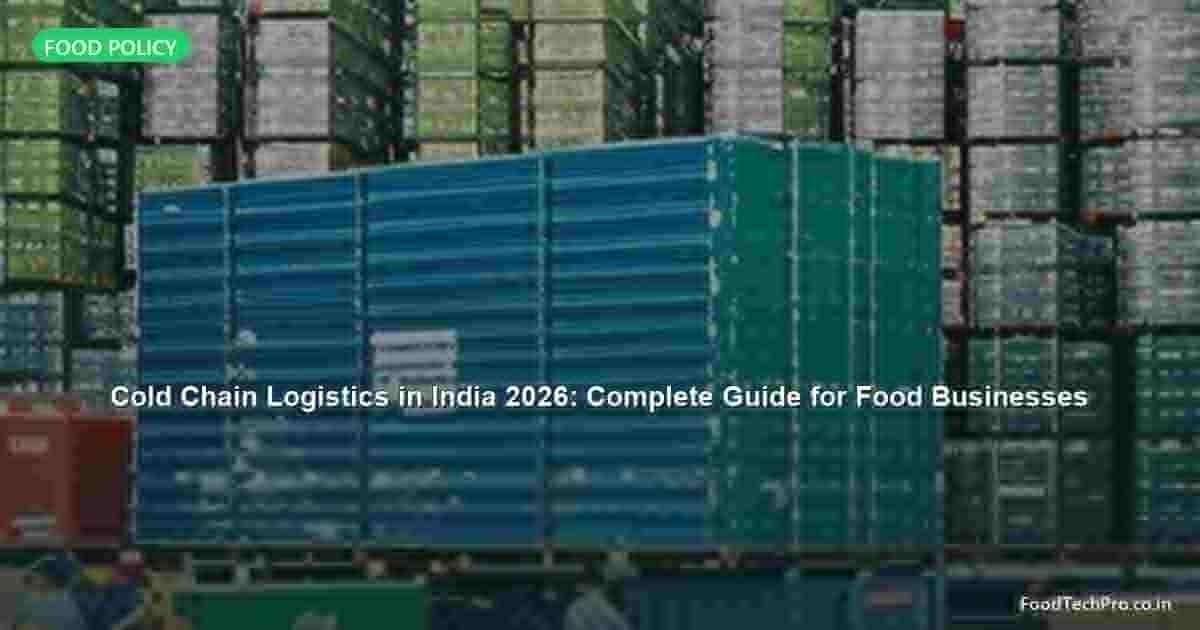
India loses approximately 16% of its fruits and vegetables and nearly 10% of its perishable food products annually due to inadequate cold chain infrastructure. That translates to an estimated economic loss of ₹92,000 crore ($11 billion) every year — a staggering figure for a country that is the world’s second-largest producer of fruits and vegetables.
Cold chain logistics is no longer optional for Indian food businesses. With tightening FSSAI regulations, growing export opportunities, and rising consumer demand for fresh and frozen products, a robust temperature-controlled supply chain is now a competitive necessity.
This comprehensive guide breaks down everything food business owners, supply chain managers, and food processing entrepreneurs need to know about cold chain logistics in India in 2026 — from market size to government schemes, compliance requirements, and future trends.
India’s Cold Chain Market: Size, Growth & Key Numbers
India’s cold chain market has been on an aggressive growth trajectory. As of 2026, the sector is valued at approximately ₹2.5 lakh crore ($30 billion), growing at a CAGR of 14-15% — outpacing most other logistics segments.
Key Market Statistics
- Cold storage capacity: ~39 million metric tonnes (up from 37 MMT in 2024)
- Number of cold storage facilities: ~8,500+
- Reefer vehicles: Over 12,000 registered refrigerated transport units
- Pack-houses with cold chain: ~400+ integrated pack-houses across major production clusters
- Ripening chambers: ~900+ facilities for controlled ripening of bananas, mangoes, and other climacteric fruits
Segment-wise Breakdown
| Segment | Share of Cold Chain Market | Growth Driver |
|---|---|---|
| Fruits & Vegetables | 30% | Export demand, organized retail |
| Dairy & Ice Cream | 25% | Amul, Mother Dairy expansion, private labels |
| Meat & Poultry | 18% | Rising protein consumption, export to Middle East/SE Asia |
| Seafood | 12% | Marine export growth, aquaculture expansion |
| Pharmaceuticals | 10% | Vaccine logistics, biopharma cold chain |
| Ready-to-Eat / Frozen Foods | 5% | ITC, Nestlé, Zomato/Hyperpure cold chain investment |
Government Schemes & Incentives for Cold Chain Development
The Indian government has placed cold chain infrastructure at the center of its food processing and agricultural policy. For food businesses, multiple schemes offer capital subsidies of 35-50% for cold chain projects.
1. PM Kisan SAMPADA Yojana (PMKSY)
The flagship scheme for food processing infrastructure, PMKSY includes a dedicated Integrated Cold Chain and Value Addition Infrastructure component:
- Subsidy: 35% of project cost (general areas), 50% for Northeast/Himalayan states/ITDP areas
- Eligible projects: Cold storage, CA/MA storage, reefer transport, IQF, blast freezing, ripening chambers
- Grant ceiling: Up to ₹10 crore per project
- Implementing agency: Ministry of Food Processing Industries (MoFPI)
2. National Horticulture Board (NHB) Schemes
- Capital Investment Subsidy: 35% subsidy for cold storage and CA storage for horticulture produce
- Maximum subsidy: ₹50 lakh per project under NHB’s credit-linked back-ended subsidy
3. APEDA
Financial assistance for pack-house/cold chain infrastructure for exporters, support for quality certification and lab testing, and market development assistance for international trade fairs.
4. NABARD — Warehouse Infrastructure Fund
- Long-term loans at concessional rates for cold storage and warehouse projects
- Refinance support to banks for cold chain lending
5. State-Level Incentives
Many states offer additional subsidies on top of central schemes:
- Maharashtra: Additional 10-15% subsidy, electricity duty exemption for cold storages
- Gujarat: Single-window clearance, land at concessional rates in food parks
- Uttar Pradesh: 100% stamp duty exemption, capital subsidy for mega food parks
- Punjab: Special incentive package for agro-processing with cold chain
Pro Tip: Stack central and state subsidies together. A well-planned cold chain project in a food park can achieve effective subsidy rates of 50-60% of project cost.
FSSAI Cold Chain Compliance: What Food Businesses Must Know
FSSAI has progressively tightened cold chain requirements across multiple categories. Non-compliance can result in license suspension, product recalls, and penalties up to ₹10 lakh.
Key FSSAI Regulations
1. Schedule 4 Compliance (Food Safety Management System)
- Temperature monitoring logs must be maintained at receipt, storage, and dispatch points
- Cold rooms must have calibrated digital temperature sensors with data logging capability
- Break in cold chain must trigger a documented CAPA (Corrective and Preventive Action)
2. FSSAI Licensing Conditions for Cold Chain-Dependent Categories
- Dairy: Raw milk must be cooled to ≤4°C within 4 hours of milking
- Meat & Poultry: Frozen meat storage at ≤-18°C; chilled meat at 0-4°C
- Seafood: IQF products stored at ≤-18°C; fresh fish at 0-2°C in flake ice
- Frozen desserts/Ice cream: Storage and transport at ≤-18°C with no temperature abuse allowed
- Ready-to-eat chilled foods: ≤4°C throughout supply chain
3. Transport & Distribution
- FSSAI now mandates temperature data loggers in reefer vehicles for high-risk categories
- Cold chain records must be retained for shelf life of product + 6 months
- Third-party logistics providers handling food must hold FSSAI Central License
Types of Cold Chain Infrastructure in India
Cold Storage Types
| Type | Temperature Range | Common Use |
|---|---|---|
| Bulk Cold Storage | 0°C to 8°C | Fruits (apple, citrus), vegetables (potato, onion) |
| Controlled Atmosphere (CA) | 0°C to 4°C | Long-term apple/pomegranate storage (up to 12 months) |
| Modified Atmosphere (MA) | Varies | Short-term transport/storage of fresh produce |
| Frozen Storage | -18°C to -25°C | Frozen vegetables, meat, seafood, ice cream, RTE foods |
| Blast Freezer | -30°C to -40°C | Quick-freezing for IQF products, seafood, meat |
| Ripening Chambers | 14°C to 24°C | Controlled ethylene ripening of bananas, mangoes, papaya |
Reefer Transport
- Reefer trucks (2-18 MT): Growing rapidly, but still only ~15% of perishable transport
- Reefer containers (20ft/40ft): Critical for export cold chain; major ports and ICDs now have reefer plug points
- Railway reefer services: Indian Railways’ Kisan Rail initiative now includes temperature-controlled wagons for select routes
- Last-mile cold chain: E-rickshaws and small reefer vans for urban distribution — emerging segment
Challenges Facing India’s Cold Chain Sector
Despite rapid growth, significant challenges remain — and understanding them helps businesses plan better.
1. Infrastructure Gap
India has cold storage for only ~12% of its perishable produce — compared to 85% in the US and 70% in China. The gap is especially acute in Eastern and Northeastern states, Tier-2 and Tier-3 cities, and farm-gate level pre-cooling facilities.
2. Power Reliability
Cold storage requires uninterrupted power. Despite improvements, many rural and semi-urban areas still face 4-8 hours of daily power cuts during summer, voltage fluctuations that damage compressor equipment, and high diesel generator backup costs (₹18-22/kWh vs ₹7-9/kWh grid power).
3. High Capital Costs
Setting up a 5,000 MT multi-commodity cold storage costs ₹5-8 crore, making it inaccessible for small and medium enterprises without subsidy support.
4. Skilled Manpower Shortage
Cold chain operations require trained personnel for refrigeration system operation and maintenance, temperature monitoring and data logging, and quality control and food safety management.
5. Fragmented Value Chain
Multiple intermediaries between farm and fork create handover points where the cold chain often breaks. Integrated players like Snowman Logistics, ColdEX, and Gubba Cold Storage are bridging this gap but penetration remains low.
Technology Trends Transforming Indian Cold Chain (2026)
IoT-Enabled Temperature Monitoring
Real-time temperature and humidity sensors with cloud-based dashboards are becoming standard. Companies like TagBox, Nimble Wireless, and Cropin offer Indian-made IoT solutions at ₹5,000-15,000 per sensor point.
- Real-time alerts for temperature excursions via SMS/email
- Predictive maintenance alerts for compressor and refrigeration systems
- Integration with ERP and FSSAI compliance reporting
Blockchain for Cold Chain Traceability
Blockchain-based traceability enables immutable temperature records throughout the supply chain, instant visibility for buyers, regulators, and consumers, and automated FSSAI compliance reporting. APEDA has piloted blockchain traceability for grape and pomegranate exports, and the technology is expanding to domestic supply chains.
AI-Powered Demand Forecasting
AI models predicting demand help cold storage operators optimize capacity utilization (currently ~65-70% average), reduce food wastage through better inventory management, and enable dynamic pricing based on seasonal demand patterns.
Solar-Powered Cold Storage
Hybrid solar-grid cold storage is gaining traction, especially for farm-gate pre-cooling. A 50 MT solar cold storage reduces operating costs by 40-60% compared to diesel-dependent units. Companies like Ecozen Solutions and Inficold lead this segment with payback periods of 2-3 years.
Investment Opportunities for Food Businesses
For Food Processors
- Captive cold chain near manufacturing units ensures quality control and reduces dependency on third-party logistics
- IQF (Individual Quick Freezing) facilities for export-grade frozen fruits and vegetables — high demand from EU and Middle East markets
- Integrated ripening + cold storage for banana, mango, and papaya supply chains
For Logistics Companies
- Multi-temperature warehouses serving pharmaceuticals + food under one roof
- Last-mile cold chain for D2C brands — the direct-to-consumer frozen foods market is growing at 20%+ CAGR
- Port-based reefer handling facilities — Mundra, JNPT, Chennai, and Vizag are expanding reefer capacity
For Agri-Entrepreneurs
- Farm-level pre-cooling and pack-house units — APEDA and NHB subsidies cover up to 50%
- Cold storage rental marketplace — aggregator model connecting small farmers to cold storage capacity
- Cold chain consulting and compliance services — huge demand for FSSAI/export compliance support
How to Get Started: 5-Step Action Plan
Step 1: Feasibility Study & Business Plan
Assess captive vs shared cold chain needs based on product category and volumes. Prepare a detailed project report (DPR) — mandatory for subsidy applications. Evaluate locations near production clusters (Nashik for grapes, Ratnagiri for mangoes, Punjab for potatoes, etc.).
Step 2: Secure Approvals & Licenses
- FSSAI Central License (mandatory for cold storage handling multiple categories)
- State Pollution Control Board consent
- Local municipal approvals (fire NOC, building plan approval)
- APEDA registration if handling exports
Step 3: Apply for Subsidies
- Primary route: MoFPI (PMKSY) for integrated cold chain projects
- Secondary route: NHB / MIDH for horticulture-specific cold storage
- Timeline: 6-12 months from application to approval
- Engage a PMKSY-empanelled consultant for faster processing
Step 4: Choose Technology & Equipment Partners
- Refrigeration system: Ammonia (cost-effective for >5,000 MT), Freon (smaller units)
- IoT/Monitoring: Mandatory for FSSAI Schedule 4 compliance
- Racking & MHE: FIFO-compatible pallet racking for food rotation
- Preferred Indian suppliers: Blue Star, Voltas, Carrier Transicold, Rinac
Step 5: Operationalize with FSSAI-Compliant SOPs
- Implement HACCP-based food safety plan
- Set up temperature monitoring and record-keeping systems
- Train staff on cold chain SOPs and emergency procedures
- Conduct mock FSSAI Schedule 4 audit before going live
The Bottom Line
India’s cold chain sector is at an inflection point. Government capital subsidies covering 35-50% of project cost, combined with regulatory tailwinds from FSSAI and growing export demand, make 2026 an opportune time for food businesses to invest in temperature-controlled infrastructure.
For food processors, a captive cold chain is no longer just a compliance requirement — it’s a competitive advantage that reduces wastage, extends shelf life, and opens access to premium markets both domestic and international.
Disclaimer: This article provides general guidance. Subsidy rates, scheme details, and regulatory requirements may change. Consult with a PMKSY-empanelled consultant or food industry advisor for project-specific planning. Always refer to the latest FSSAI notifications at fssai.gov.in for current regulations.

Prashant Chavhan
Prashant Chavhan is a food technologist and industry consultant based in India, specializing in FSSAI compliance, food safety management systems (HACCP/ISO 22000), and food processing business setup. With years of hands-on experience in the Indian food industry, he founded FoodTechPro.co.in to bridge the gap between regulatory requirements and practical implementation for food entrepreneurs and professionals.